Annuities and taxes

Explore the potential tax advantages of annuities and understand how the IRS treats this retirement investment product.

Mature woman reviewing finances at home.

Annuities can offer steady income and tax benefits, making them a popular way to fund retirement. However, an annuity’s tax benefits will ultimately depend on the type of annuity you choose. 

Your Ameriprise financial advisor can help determine what type of annuity can help reach your goals and account for the impact of taxes on your retirement savings and income. 
 
Here’s how annuities are taxed: 

How are annuities taxed? 

An annuity’s tax treatment is determined by the specific type of annuity you purchase — immediate or deferred — and how the annuity is funded. 

How are immediate annuities taxed? 

Immediate annuities are purchased with a single lump-sum payment and, in exchange, pay a guaranteed income that starts immediately. How that income is taxed depends on whether the lump sum is funded with pretax or after-tax dollars: 

  • Pretax funding: If the annuity is purchased with pretax dollars, such as funds from a traditional IRA or 401(k), all payments are taxed as ordinary income.  

  • After-tax funding: If the annuity is purchased with after‑tax dollars, only a portion of each payment is taxable. Each payment you receive is generally a mix of: 

    • A return of the principal which is not taxed because taxes were already paid on those dollars.

    • Earnings, which are taxed as ordinary income.

How are deferred annuities taxed? 

Deferred annuities accumulate earnings tax-deferred and are taxed based on whether you purchase a qualified or non-qualified deferred annuity. 

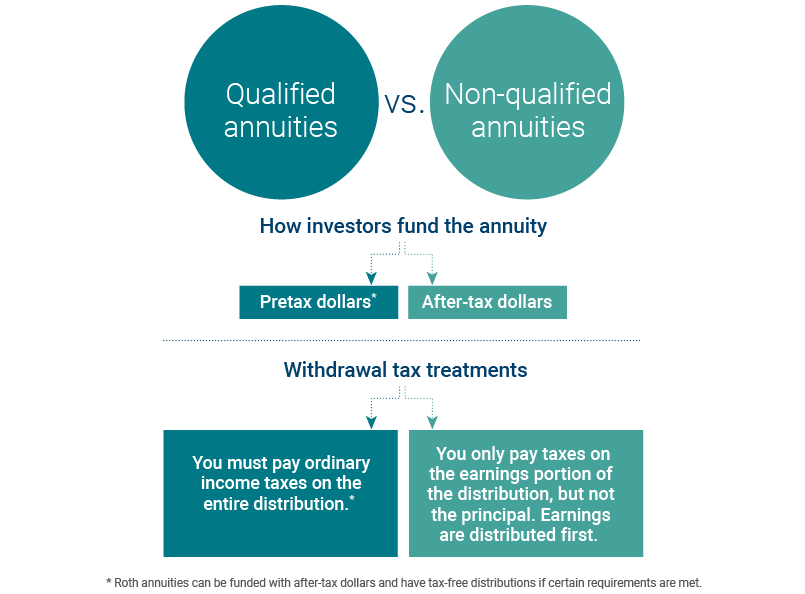
  • Qualified deferred annuities are purchased through a qualified retirement account, such as a traditional or Roth IRA, which means your annuity’s distributions are subject to the same tax rules that govern those accounts. Generally, qualified annuities are funded with pretax dollars, though Roth annuities are funded with after-tax money.  

  • Non-qualified deferred annuities are not purchased through a qualified retirement account.  Instead, they are funded with after-tax dollars (i.e., cash). As such, the funding limits and contribution rules that apply to qualified retirement accounts do not apply. With non-qualified annuities, the distributions of earnings are taxed as ordinary income, but you won’t pay taxes on distributions of the premium or principal you initially deposited. However, unlike after‑tax immediate annuities, deferred annuities follow an “earnings‑first” withdrawal rule. This means any withdrawals are fully taxable as ordinary income until earnings are depleted.
What are the tax implications of early withdrawals from a deferred annuity?

An annuity can be a smart addition to your retirement income strategy, but know that if you make a withdrawal prior to the designated time period, you may be subject to pay an early withdrawal penalty from the IRS, as well as potential surrender charges from the annuity issuer.1 Generally, annuity withdrawals made before age 59½ are subject to the IRS 10% early withdrawal penalty.

  • If you withdraw money early from a pretax qualified annuity: The entire distribution amount may be subject to the penalty.
  • If you withdraw money early from a non-qualified annuity: Typically, only withdrawn earnings will be subject to the penalty.

While there aren’t many exceptions to the 10% early withdrawal penalty, you can explore potential options with your tax professional that may be available to you based on your individual circumstances.

Find an annuity that works for you

There are a variety of annuities that can help meet your retirement savings goals, income needs and tax situation. An Ameriprise financial advisor can evaluate your finances holistically and help determine which type of annuity may be appropriate for you.

Hello,

One of your clients has some questions they would like to discuss with you at your next meeting.
At Ameriprise Financial, we're committed to protecting your privacy and online security. To learn more, view our Privacy Notices on the Ameriprise.com Privacy, Security & Fraud Center. We will only use the information you are providing to send offers we believe are relevant to you and to send you information about your accounts.

warning Something went wrong. Do you want to try reloading? Try again

What kind of tax advantages can an annuity offer me in retirement? Does it make more sense for me to fund an annuity with pretax or after-tax funds? I’ve maxed out my 401(k) and IRA. Should I consider purchasing a non-qualified deferred annuity to continue to save for retirement in a tax-efficient manner?

When you’re ready to reach out to an Ameriprise financial advisor for a complimentary initial consultation, consider bringing these questions to your meeting.

Client Action: Your client has questions they would like to discuss
What kind of tax advantages can an annuity offer me in retirement? Does it make more sense for me to fund an annuity with pretax or after-tax funds? I’ve maxed out my 401(k) and IRA. Should I consider purchasing a non-qualified deferred annuity to continue to save for retirement in a tax-efficient manner?

Reach out to %advisor% to start the conversation.

Client Action: Your client has questions they would like to discuss Hello, I recently read the article %article% on ameriprise.com and I’d like to discuss it with you at our next meeting. Some of the questions I’d like to review are: • What kind of tax advantages can an annuity offer me in retirement? • Does it make more sense for me to fund an annuity with pretax or after-tax funds? • I’ve maxed out my 401(k) and IRA. Should I consider purchasing a non-qualified deferred annuity to continue to save for retirement in a tax-efficient manner? Thank you
What is an annuity? Understanding the basics /financial-goals-priorities/investing/what-are-annuities/ Debunking common annuity myths https://www.ameriprise.com/financial-goals-priorities/retirement/annuity-myths-debunked How are my investments taxed? 4 questions to ask https://www.ameriprise.com/financial-goals-priorities/taxes/how-are-my-investments-taxed
Get a retirement strategy that’s personalized to you.

Or, request an appointment online to speak with an advisor.

At Ameriprise, the financial advice we give each of our clients is personalized, based on your goals and no one else's. 

If you know someone who could benefit from a conversation, please refer me.

Background and qualification information is available at FINRA's BrokerCheck website.

1You may incur surrender charges if the amount withdrawn exceeds any penalty-free amount during the surrender charge period. Surrender charges vary by the annuity product you purchase, so make sure to check with the annuity issuer before withdrawing money from an annuity. 
Ameriprise Financial cannot guarantee future financial results. 
The initial consultation provides an overview of financial planning concepts. You will not receive written analysis and/or recommendations. 
This information is being provided only as a general source of information and is not a solicitation to buy or sell any securities, accounts or strategies mentioned.  The information is not intended to be used as the sole basis for investment decisions, nor should it be construed as a recommendation or advice designed to meet the particular needs of an individual investor.  Please seek the advice of a financial advisor regarding your particular financial situation. 
Before you purchase, be sure to ask your financial professional about the annuity’s features, benefits, risks and fees, and whether the annuity is appropriate for you, based on your financial situation and objectives. Variable annuities are complex investment vehicles that are subject to market risk, including the potential loss of principal invested. Annuities are long-term insurance products. 
Most annuities have a tax-deferred feature. So do many retirement plans under the Internal Revenue Code. As a result, when you use an annuity to fund a retirement plan that is tax-deferred, your annuity will not provide any necessary or additional deferral for that retirement plan. But annuities do have features other than tax deferral that may help you reach your retirement goals. You should consult your tax adviser prior to making a purchase for an explanation of the tax implications.
Surrenders that do not qualify for a waiver may be subject to a surrender charge. Surrenders are subject to income taxes and surrenders before age 59-1/2 may incur an IRS 10% early withdrawal penalty. 
All guarantees are subject to the claims-paying ability of the issuing insurance company.
Withdrawals from a Roth account are tax-free as long as investors leave the money in the account for at least 5 years and are 59 1/2 or older when they take distributions or meet another qualifying event such as death or disability.
Ameriprise Financial, Inc. and its affiliates do not offer tax or legal advice. Consumers should consult with their tax advisor or attorney regarding their specific situation.
Investment products are not insured by the FDIC, NCUA or any federal agency, are not deposits or obligations of, or guaranteed by any financial institution, and involve investment risks including possible loss of principal and fluctuation in value.
Investment advisory products and services are made available through Ameriprise Financial Services, LLC, a registered investment adviser.
Securities offered by Ameriprise Financial Services, LLC. Member FINRA and SIPC.