Will inflation keep rising? What to expect in 2026
Russell Price, Chief Economist – Ameriprise Financial
April 20, 2026
After peaking in 2022, inflation has generally eased. But that momentum could stall — or even reverse in 2026 — the conflict in Iran persists.
Below, we share our updated inflation projections and what higher prices could mean for U.S. economic growth.
Why prices are rising again
The outbreak of hostilities in the Middle East has put upward pressure on energy prices, contributing to a sharp rise in inflation.
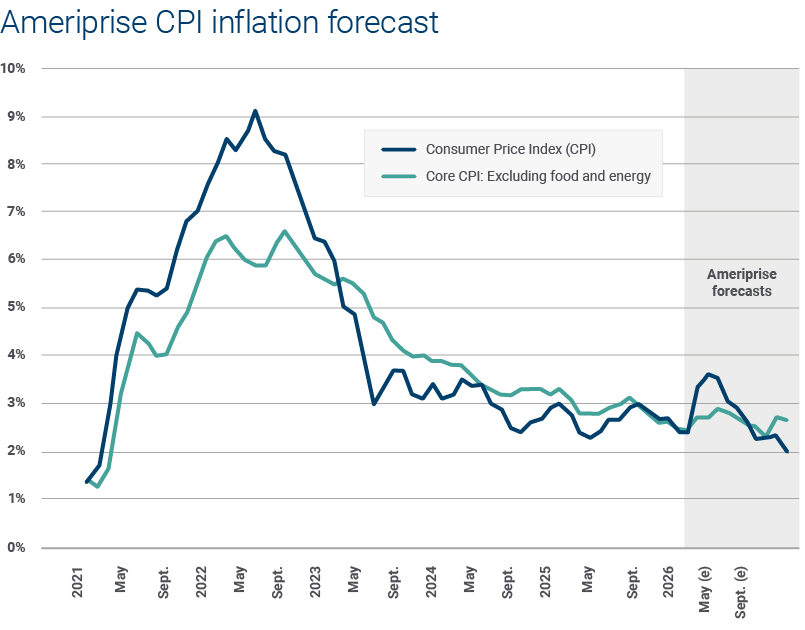
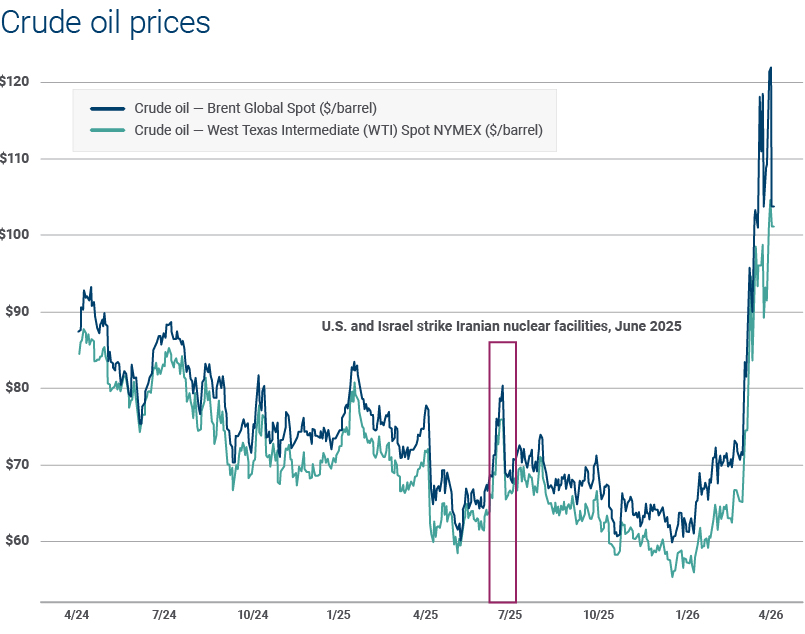
Prior to the Iran conflict, inflation, as measured by the Consumer Price Index (CPI), rose +2.4% year-over-year in February, near the Federal Reserve’s 2.0% target. Following the Iran conflict, however, crude oil prices immediately surged and inflation jumped +0.9% in March, pushing the year-over-year rate to roughly +3.3%. At the time of this writing, gasoline prices are already more than $1.00 higher per gallon, with the national average hovering at $4.00 per gallon.
This jump in consumer prices is the third inflation surge in the last five years:
-
2022: Just after the pandemic, consumer prices jumped sharply as demand for goods expanded even though many factories were still closed, with CPI peaking at +9.1% in June 2022. Prices slowly subsided as factory output caught up to demand and the Fed pushed interest rates aggressively higher.
-
2025: Inflation eventually fell to +2.4% by April. However, that same month the Trump administration announced significant new trade tariffs. The higher import costs that followed pushed inflation back up to +3.0% by September, followed by a period of easing inflation.
Source: FactSet Research Systems
Will this spike in inflation be fleeting or stubborn?
Inflation’s intermediate-term path will be highly dependent on the Iran situation, notably its duration and navigation conditions in the Strait of Hormuz. In addition to higher crude oil and natural gas prices, food prices are also likely to go higher due to higher fertilizer costs, and plastic prices could broadly rise as well.
Every $10 increase in the price of West Texas Intermediate (WTI) crude oil increases the cost of gasoline at the pump by about $0.20 to $0.30 per gallon. Price hikes could be larger over the next few months (assuming current circumstances continue) as refiners transition to producing summer blend gasolines, which require additional inputs to curtail evaporation. Summer blend formulations typically add about $0.15 per gallon.
There’s a very high degree of uncertainty with this situation, but we believe that WTI crude oil prices could trade in a broad range of $90 to $120 per barrel over the next few months, leading national average gasoline prices to see a corresponding range of about $4.00 to $5.00 per gallon. If that occurs, inflation could peak at a rate of about +3.5% in the second quarter.
However, there may be some price relief for consumers elsewhere: Inflation should see some modest downside from reduced tariff pressures. In late January, the Supreme Court struck down the Trump administration’s use of the International Emergency Economic Powers Act (IEEPA) as a basis for its tariff strategy. We estimate that approximately 60% of the tariffs employed by the administration have come under this act. The elimination of this pathway should reduce business and consumer costs, thus offering some modest downside to consumer prices for imported goods.
Source: FactSet Research Systems
How higher inflation may impact economic growth
Higher inflation is also a direct threat to economic prospects. As a result of the conflict in Iran and higher energy prices, we’ve lowered our gross domestic product (GDP) growth forecast for 2026 down to +2.2% from the +2.6% from which we started the year. Additional downside should be expected if WTI crude oil were to surpass $120 per barrel for a sustained period of three or more months.
Specifically, we estimate that every 10% hike in crude oil prices reduces U.S. GDP by approximately 0.3% to 0.4% on an annualized basis. Most of the negative economic impact is transmitted through reduced consumer spending power.
Despite this situation, we believe U.S. economic fundamentals remain on solid footing. Consumer debt burdens are low and corporate balance sheets are arguably strong in aggregate. Business investment spending should also provide strong support for economic growth this year as businesses pursue potential productivity gains from artificial intelligence.
Get help navigating uncertainty
When economic and market conditions shift, know that you can lean on your Ameriprise financial advisor for guidance and support. They can provide you with the latest economic and market insights from the Ameriprise Financial Investment Research Group and help you make sense of the potential impacts on your portfolio and financial goals.
Or, request an appointment online to speak with an advisor.
At Ameriprise, the financial advice we give each of our clients is personalized, based on your goals and no one else's.
If you know someone who could benefit from a conversation, please refer me.
Background and qualification information is available at FINRA's BrokerCheck website.
The views expressed are as of the date given, may change as market or other conditions change, and may differ from views expressed by other Ameriprise Financial associates or affiliates. Actual investments or investment decisions made by Ameriprise Financial and its affiliates, whether for its own account or on behalf of clients, will not necessarily reflect the views expressed. This information is not intended to provide investment advice and does not account for individual investor circumstances.
The information is not intended to be used as the sole basis for investment decisions, nor should it be construed as advice designed to meet the specific needs of an individual investor.
Ameriprise Financial, Inc. and its affiliates do not offer tax or legal advice. Consumers should consult with their tax advisor or attorney regarding their specific situation.
Investment products are not insured by the FDIC, NCUA or any federal agency, are not deposits or obligations of, or guaranteed by any financial institution, and involve investment risks including possible loss of principal and fluctuation in value.
Securities offered by Ameriprise Financial Services, LLC. Member FINRA and SIPC.