What higher-for-longer interest rates could mean for your portfolio
Brian Erickson, Fixed Income Strategist – Ameriprise Financial
August 17, 2026
Inflation has come down from its peak, but it remains above the Federal Reserve's long-term target, which could keep interest rates higher for longer. That shift has implications across a broader portfolio, from how investors manage cash to how they balance income, risk and diversification.
In this higher-for-longer rate environment, fixed income may now play a more useful role in helping support your long-term financial goals. Here are four opportunities to consider as the Fed holds rates steady:
1. Look for income potential again
Higher rates today may again offer meaningful income across short-, intermediate- and long-term strategies. In fact, intermediate- and long-term bond yields are near two-decade highs. That changes the role bonds can play in long-term income planning. For retirees and those approaching retirement, today's yield environment may allow some investors to generate income with less risk-taking than what was often necessary during years of exceptionally low yields. Investors who need a steady income through retirement may have more room to use high-quality bonds as a core source of cash flow, in addition to other retirement income sources.
Price changes will still occur, but investors who hold bonds primarily for income may be less sensitive to short-term price fluctuations when the underlying investments continue to generate income.
Learn more: What to know about bonds and fixed income investing
2. Consider putting excess cash to work
Maintaining liquid cash reserves for emergencies and near-term spending needs remains important. However, holding too much cash for too long can limit long-term growth and income opportunities. While cash yields may look attractive now, they can fall quickly if the Federal Reserve eventually cuts rates.
Investors who may have accumulated large cash balances in savings vehicles, such as money markets, have several options in a high-rate environment. Depending on individual goals and time horizons, some of those assets may be better positioned in investments that can potentially provide higher income or more reliable long-term returns. Short- and intermediate-term bonds may help investors lock in today’s higher yields for longer.
Learn more: How much cash should I have in my portfolio?
3. Upgrade to higher quality bond investments
During the low-rate era, investors may have added riskier, lower-quality or more complex fixed income holdings to their portfolio in search of additional income or return potential. Today, quality pays more than it used to.
Many investment-grade corporate, U.S. Treasuries and municipal bonds now offer yields that are higher than those available just a few years ago. Higher yields from these high-quality fixed income investments may give some investors an opportunity to:
-
Reduce risk and complexity in their fixed income allocation
-
Improve overall portfolio quality
-
Continue earning attractive income while staying aligned with their investment objectives
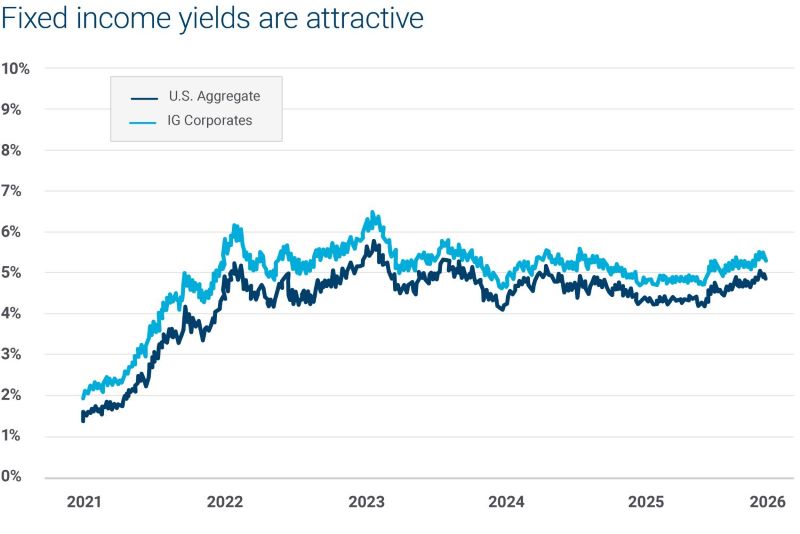
Source: Bloomberg L.P. Bloomberg US Aggregate Bond Index. This example is shown for illustrative purposes only and is not guaranteed. It is not possible to invest directly in an index. Past performance is not a guarantee of future results.
4. Continue to prioritize diversification
While rates are higher, uncertainty remains. Inflation, economic growth, government spending and central bank policy will continue to influence markets. At the same time, rising government debt and borrowing needs may keep upward pressure on long-term bond yields.
These factors reinforce the value of diversification across a broader portfolio and within fixed income. Depending on an investor’s goals and tax situation, a diversified bond allocation may include Treasuries, agencies, investment-grade corporate bonds, foreign bonds and municipal bonds. This approach can help manage risk, create multiple sources of return and provide greater confidence during periods of market volatility.
Learn more: Why should an investor consider diversification and asset allocation?
Bottom line
The higher-rate environment has created challenges, but it has also opened new opportunities for investors. Rather than waiting to see where interest rates may go next, investors should consider whether their financial strategy is positioned for today's reality. Reviewing cash and fixed income strategies may help strengthen long-term financial outcomes and keep investment decisions aligned with personal goals.
Put today’s opportunities to work
An Ameriprise financial advisor can help you assess your portfolio and identify ways to take advantage of today's higher-rate environment while staying focused on your long-term financial goals.
Or, request an appointment online to speak with an advisor.
At Ameriprise, the financial advice we give each of our clients is personalized, based on your goals and no one else's.
If you know someone who could benefit from a conversation, please refer me.
Background and qualification information is available at FINRA's BrokerCheck website.
The views expressed are as of the date given, may change as market or other conditions change, and may differ from views expressed by other Ameriprise Financial associates or affiliates. Actual investments or investment decisions made by Ameriprise Financial and its affiliates, whether for its own account or on behalf of clients, will not necessarily reflect the views expressed. This information is not intended to provide investment advice and does not account for individual investor circumstances.
Some of the opinions, conclusions and forward-looking statements are based on an analysis of information compiled from third-party sources. This information has been obtained from sources believed to be reliable, but accuracy and completeness cannot be guaranteed by Ameriprise Financial. It is given for informational purposes only and is not a solicitation to buy or sell the securities mentioned. The information is not intended to be used as the sole basis for investment decisions, nor should it be construed as advice designed to meet the specific needs of an individual investor.
Diversification does not assure a profit or protect against loss.
There are risks associated with fixed-income investments, including credit (issuer default) risk, interest rate risk, and prepayment and extension risk. In general, bond prices rise when interest rates fall and vice versa. This effect is usually more pronounced for longer term securities.
International investing involves certain risks and volatility due to potential political, economic, social, or currency instabilities and different financial and accounting standards. These risks are enhanced for emerging markets.
Investments in municipal securities will be affected by tax, legislative, regulatory, demographic or political changes, as well as changes impacting a state’s financial, economic or other conditions.
Past performance is not a guarantee of future results.
An index is a statistical composite that is not managed. It is not possible to invest directly in an index.
Bloomberg US Aggregate Bond Index is a broad-based flagship benchmark that measures the investment grade, US dollar-denominated, fixed-rate taxable bond market. The index includes Treasuries, government-related and corporate securities, MBS (agency fixed-rate and hybrid ARM pass throughs), ABS and CMBS (agency and non-agency).
Ameriprise Financial, Inc. and its affiliates do not offer tax or legal advice. Consumers should consult with their tax advisor or attorney regarding their specific situation.
Investment products are not insured by the FDIC, NCUA or any federal agency, are not deposits or obligations of, or guaranteed by any financial institution, and involve investment risks including possible loss of principal and fluctuation in value.
Securities offered by Ameriprise Financial Services, LLC. Member FINRA and SIPC.