How the K-shaped economy is shaping markets
Russell Price, Chief Economist – Ameriprise Financial
Anthony Saglimbene, Chief Market Strategist – Ameriprise Financial
Sept. 14, 2026

Strong stock market performance and a resilient economy have been two defining features of the current environment. Yet beneath those headline trends, the picture appears more nuanced. While many households continue to benefit from stable employment, rising asset values and solid spending power, others remain challenged by the cumulative effects of higher living costs and inflation pressures.
This divergence helps explain why economic sentiment and economic data can sometimes tell seemingly different stories. It also highlights a concept that has gained increasing attention among economists and market observers: the "K-shaped economy."
Here's an overview of what the K-shaped economy is, what it tells us about today's uneven economic landscape and why it matters for investors.
What is a K-shaped economy?
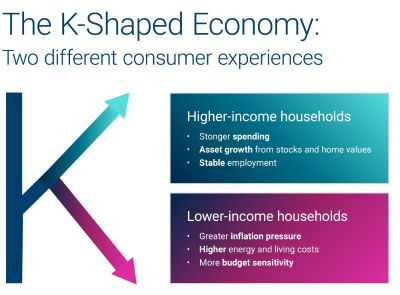
A K-shaped economy describes an environment in which different segments of the economy experience markedly different outcomes. Rather than moving in the same direction, one group advances while another lags behind, creating a pattern that resembles the letter "K."
Why does the K-shape economy matter today?
Today, the term is often used to describe the gap between higher- and lower-income consumers. While higher-income households have generally benefited from strong asset values and stable employment, many lower-income consumers have faced greater pressure from inflation and higher living costs.
This divergence matters because consumer spending accounts for a large portion of economic activity. Even when overall spending remains healthy, aggregate figures can sometimes mask meaningful differences beneath the surface. Strong spending by upper-income households may keep headline economic data looking solid, even if other groups are feeling greater financial strain.
The stock market has its own K-shape
The K-shaped dynamic is not limited to consumers. It has also appeared in financial markets, where a divergence is emerging between a handful of market leaders and the broader stock market.
Over the past several years, a relatively small number of large technology and communication services companies have accounted for a disproportionate share of market gains. Strong demand for artificial intelligence infrastructure and services has helped fuel earnings growth among some of the largest companies in the market, supporting broader index performance.
As a result, major market indexes can post impressive gains even when many individual stocks are experiencing more modest performance. In other words, a handful of leaders may be carrying much of the market higher while other sectors move sideways.
For investors, this can create the impression that markets are stronger across the board than they actually are. Looking beyond headline index returns and understanding what is driving performance becomes increasingly important when market leadership is concentrated in a narrow group of companies.
What could change the K-shape?
The K-shape phenomenon occurring within both the markets and economy could certainly switch course. If inflation pressures ease, energy costs stabilize and wage growth remains healthy, consumer spending could become more broadly distributed across income groups. Similarly, corporate earnings growth may expand beyond today's market leaders, allowing a wider range of sectors and companies to participate in future gains.
There are already signs that conditions may be evolving. The broader economy continues to grow, the labor market has remained relatively stable and some measures of lower-income spending have improved.
For example, recent data shows that spending growth among lower-income consumers has improved in recent months, bringing it closer to other income segments. While some of that improvement may be tied to temporary factors, such as larger tax refunds, it suggests the gap may not be widening indefinitely.
Bottom line: While K-shaped challenges remain, the data suggests the economy is more nuanced than the K-shaped narrative alone might imply.
What a K-shaped economy means for portfolios
Overall, the K-shaped framework can be a useful lens for understanding today's economic and market environment. While investors can't control broader economic trends, they can position their portfolios to navigate periods of uneven growth and concentrated market leadership by considering the following:
-
Look beyond headline economic data. Strong overall growth can mask meaningful differences in spending, financial health and economic confidence across consumer groups.
-
Pay attention to market concentration. A relatively small number of companies have driven a significant share of recent market gains, making it important to understand what's fueling index performance.
-
Maintain diversification. Broad exposure across sectors, asset classes and investment styles can help reduce reliance on any single market theme or group of companies.
-
Revisit portfolio allocations periodically. When a small group of investments outperforms for an extended period, portfolios can become unintentionally concentrated. Regular reviews can help ensure investments remain aligned with your goals and risk tolerance.
-
Watch for shifts in market leadership. If economic conditions improve and earnings growth broadens, sectors that have lagged market leaders could have greater opportunities to participate in future gains.
-
Stay focused on long-term goals. Economic and market narratives can change over time. Maintaining a disciplined investment approach aligned with your objectives remains important regardless of short-term trends.
Overall, the K-shaped economy highlights that not all parts of the economy and market move together. For investors, understanding these differences can provide valuable context when evaluating risks, opportunities and long-term portfolio decisions.
Make sense of the current market and economic environment
Your Ameriprise financial advisor is here to help you understand the implications of current macroeconomic trends, like the K-shaped economy, on your personal portfolio and investment strategy.
Or, request an appointment online to speak with an advisor.
At Ameriprise, the financial advice we give each of our clients is personalized, based on your goals and no one else's.
If you know someone who could benefit from a conversation, please refer me.
Background and qualification information is available at FINRA's BrokerCheck website.
The views expressed are as of the date given, may change as market or other conditions change, and may differ from views expressed by other Ameriprise Financial associates or affiliates. Actual investments or investment decisions made by Ameriprise Financial and its affiliates, whether for its own account or on behalf of clients, will not necessarily reflect the views expressed. This information is not intended to provide investment advice and does not account for individual investor circumstances.
Some of the opinions, conclusions and forward-looking statements are based on an analysis of information compiled from third-party sources. This information has been obtained from sources believed to be reliable, but accuracy and completeness cannot be guaranteed by Ameriprise Financial. It is given for informational purposes only and is not a solicitation to buy or sell the securities mentioned. There is no guarantee that investment objectives will be achieved or that any particular investment will be profitable.
The information is not intended to be used as the sole basis for investment decisions, nor should it be construed as advice designed to meet the specific needs of an individual investor.
Diversification does not assure a profit or protect against loss.
Stock investments involve risk, including loss of principal. High-quality stocks may be appropriate for some investment strategies. Ensure that your investment objectives, time horizon and risk tolerance are aligned with investing in stocks, as they can lose value.
Ameriprise Financial, Inc. and its affiliates do not offer tax or legal advice. Consumers should consult with their tax advisor or attorney regarding their specific situation.
Investment products are not insured by the FDIC, NCUA or any federal agency, are not deposits or obligations of, or guaranteed by any financial institution, and involve investment risks including possible loss of principal and fluctuation in value.
Securities offered by Ameriprise Financial Services, LLC. Member FINRA and SIPC.