The ripple effects of a rising 10-year Treasury yield
Brian Erickson, Fixed Income Strategist – Ameriprise Financial
Oct. 19, 2026

The 10-year U.S. Treasury yield has risen to levels not seen in nearly two decades.
While that may sound like a technical bond market development, the 10-year Treasury yield is a key benchmark for interest rates across the economy, and its impact reaches far beyond Wall Street.
Understanding why it is moving higher can help put its ripple effects on government finances, household borrowing, businesses and investment portfolios into perspective.
Here’s what’s driving that increase — and what it may mean for you.
What is the 10-year U.S. Treasury yield?
The 10-year U.S. Treasury yield is one of the economy’s most important benchmark rates, influencing how much it costs the government, households and companies to borrow money. More specifically, it is the return investors receive for lending money to the U.S. government for 10 years by purchasing a 10-year Treasury note.
One simple way to think about it: the 10-year Treasury yield is like the base price of a widely purchased new car model. Few buyers pay only that number once they choose a trim level, options, financing terms and dealer fees. But the base price still anchors the rest of the pricing structure. If it rises, the cost of upgraded versions usually rises too. In a similar way, U.S. Treasuries are viewed as among the lowest risk and most actively traded investments, making them a visible, market-sensitive benchmark. Lenders and investors often start with Treasury yields and then add extra compensation for risks such as credit quality, time and uncertainty.
Why is the 10-year U.S. Treasury yield moving higher?
The 10-year U.S. Treasury yield is moving higher as resilient economic growth and persistent inflation raise expectations that interest rates may remain elevated. At the same time, increased government and corporate borrowing is adding to the supply of bonds, prompting investors to demand higher yields to hold longer-term debt. Because bond prices and yields move in opposite directions, selling pressure in the bond market can push yields higher as well.
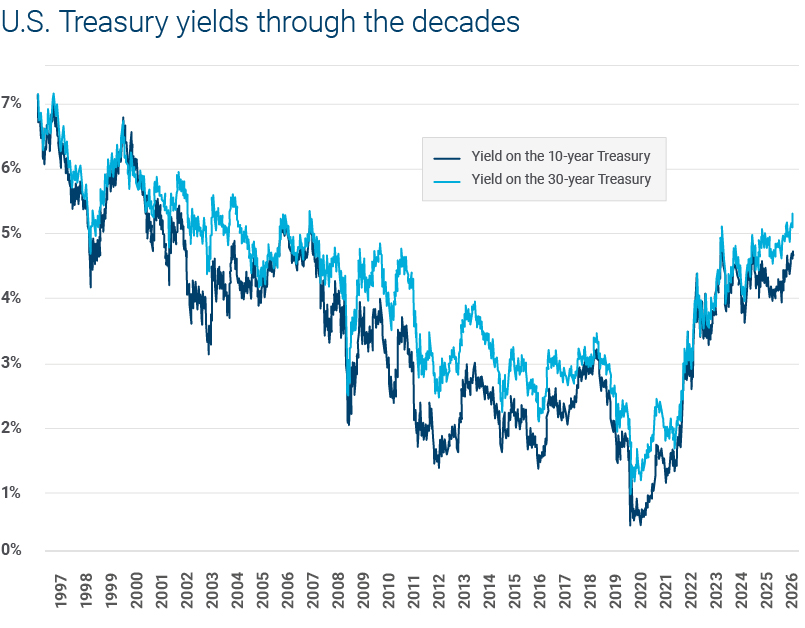
Source: FactSet Research Systems. This example is shown for illustrative purposes only and is not guaranteed. Past performance is not a guarantee of future results
What are the impacts of rising Treasury yields?
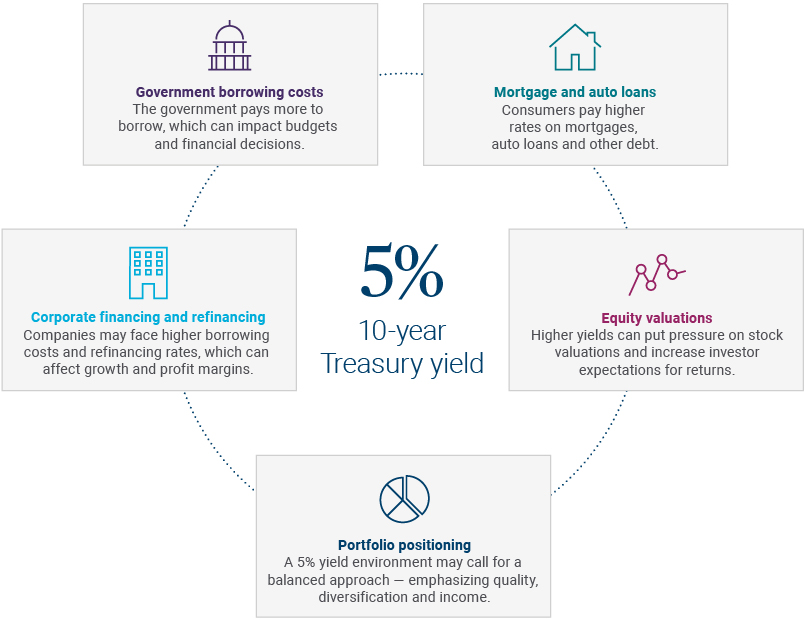
Because the 10-year Treasury yield helps set the baseline for borrowing costs across the economy, an increase can create ripple effects for the federal government, households, companies and financial markets.
- Federal government: Higher Treasury yields mean higher interest costs. The effect is gradual because not all government debt is refinanced at once. But as older debt matures and new debt is issued, higher rates can raise the cost of servicing the national debt. Over time, that can put more pressure on the federal budget and make interest payments a larger share of government spending, crowding out other spending priorities.
- Households: Consumers can feel the effect more directly. Mortgage rates often move with the 10-year Treasury because both reflect long-term interest-rate expectations. When the 10-year yield rises, mortgage rates often rise as well, making monthly payments more expensive and reducing what buyers can afford. A higher-rate environment can also cool housing activity, because existing homeowners with low-rate mortgages may be reluctant to sell and take on a new loan at a much higher rate. Auto loans can be affected too, making vehicle purchases more expensive to finance and taking a bigger bite out of household budgets.
- Companies: Businesses borrow to build factories, buy equipment, expand operations or refinance existing debt. Many corporate borrowing rates are tied to Treasury yields plus an added amount that reflects the company’s financial strength. When the Treasury starting point is higher, new borrowing becomes more expensive. Companies with large amounts of debt coming due may see profits squeezed as they refinance at higher rates. In some cases, that can lead businesses to delay investment, slow hiring or focus more on preserving cash.
- Stocks: When lower risk bonds offer higher income, investors may demand a better potential return from stocks. Higher interest rates can also place a lower value on profits expected far in the future, which may weigh more heavily on companies whose valuations depend on strong growth many years from now.
What might rising U.S. Treasury yields mean for my investments?
Higher yields are not all good nor all bad for portfolios. They can create both opportunities and risks for investors:
- Opportunities: On the positive side, bonds may offer more meaningful income than they did in the very low-rate years. Investors may be better compensated for owning high-quality fixed income.
- Risks: On the other hand, bond prices can remain volatile if yields continue to rise, and higher borrowing costs can pressure parts of the stock market and economy.
Higher yields can create both opportunities and challenges, but they aren’t necessarily a reason to make major portfolio changes. A more measured approach may involve emphasizing quality in bonds, being thoughtful about interest-rate sensitivity and maintaining diversified equity exposure.
Bottom line
A 5% 10-year Treasury yield is not just a number on a screen. It is a signal that the price of money has changed — and that change can ripple across budgets, businesses, markets and portfolios.
Put changing yields in perspective
Connect with an Ameriprise financial advisor to discuss how changing Treasury yields may affect your portfolio and long-term financial goals.
Or, request an appointment online to speak with an advisor.
At Ameriprise, the financial advice we give each of our clients is personalized, based on your goals and no one else's.
If you know someone who could benefit from a conversation, please refer me.
Background and qualification information is available at FINRA's BrokerCheck website.
The views expressed are as of the date given, may change as market or other conditions change, and may differ from views expressed by other Ameriprise Financial associates or affiliates. Actual investments or investment decisions made by Ameriprise Financial and its affiliates, whether for its own account or on behalf of clients, will not necessarily reflect the views expressed. This information is not intended to provide investment advice and does not account for individual investor circumstances.
Some of the opinions, conclusions and forward-looking statements are based on an analysis of information compiled from third-party sources. This information has been obtained from sources believed to be reliable, but accuracy and completeness cannot be guaranteed by Ameriprise Financial.
This article is given for informational purposes only and is not a solicitation to buy or sell the securities mentioned. The information is not intended to be used as the sole basis for investment decisions, nor should it be construed as advice designed to meet the specific needs of an individual investor. Please seek the advice of a financial advisor regarding your particular financial situation.
There are risks associated with fixed-income investments, including credit (issuer default) risk, interest rate risk, and prepayment and extension risk.
In general, bond prices rise when interest rates fall and vice versa. This effect is usually more pronounced for longer term securities.
10-year U.S. Treasury yield: The annualized return investors earn by holding a U.S. Treasury note with a 10-year maturity to maturity. It is widely viewed as a benchmark interest rate and is often used as an indicator of investor expectations for economic growth, inflation, and future interest rates
Investment products are not insured by the FDIC, NCUA or any federal agency, are not deposits or obligations of, or guaranteed by any financial institution, and involve investment risks including possible loss of principal and fluctuation in value.
Securities offered by Ameriprise Financial Services, LLC. Member FINRA and SIPC.