AI circular financing: Uncomplicating the complicated
ANTHONY SAGLIMBENE – CHIEF MARKET STRATEGIST, AMERIPRISE FINANCIAL
WEEKLY MARKET PERSPECTIVES — September 8, 2026

U.S. stocks edged higher last week, with the S&P 500 Index and NASDAQ Composite both posting a second straight weekly gain, and their fifth gain in the past six weeks. This week’s inflation data will likely play a key role in shaping whether the Federal Reserve raises its policy rate or holds steady this month.
Last week in review:
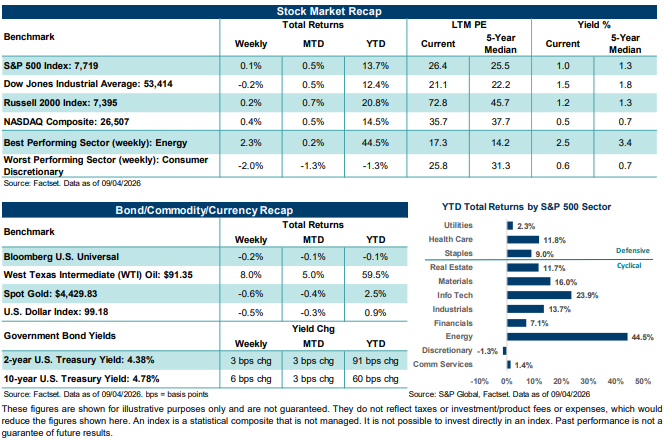
- U.S. stock averages eked out small gains for the week (minus the Dow). Energy and Technology led sector performance, while Consumer Discretionary and Materials lagged.
- August nonfarm payrolls rose +162,000, well ahead of the roughly +55,000 consensus estimate, with the prior two months revised higher by a combined +55,000. The unemployment rate held at 4.1%. ISM Services rose to a six-month high, though ISM Manufacturing missed consensus, with new orders, production, and employment components all softening.
- Fed rate path expectations were volatile. The probability of a 25-basis-point hike at the September meeting rose to roughly 65% early in the week, following Fed Chair Kevin Warsh's hawkish remarks at Jackson Hole. Odds then fell to roughly 50% on Thursday after more dovish commentary from Fed Governor Christopher Waller, who said he would support holding rates steady if upcoming inflation data continues to show disinflation. Odds of a September rate hike then moved back up to roughly 60% following Friday's stronger-than-expected August payrolls report.
- Treasury yields finished mixed on the week. The U.S. Dollar Index fell 0.6% on yen strength tied to intervention speculation. Gold fell 1.2%, and West Texas Intermediate (WTI) crude rose +9.7%.
- Geopolitical developments evolved in the background. Oil flows through the Strait of Hormuz reached their highest level since the conflict began, though U.S. retail diesel prices hit a fresh record above $5.85 per gallon.
Notably, the AI narrative remained constructive. Broadcom and Dell both raised AI-related guidance on strong infrastructure demand, while a new model release from OpenAI (GPT-6 Astra) drew significant investor attention. Yet, retail earnings were a weak spot, with Lululemon among the notable decliners.
“AI financing today is complex and moving fast. Multibillion-dollar arrangements are being struck in weeks, not quarters, and they knit suppliers, financiers, and customers together in ways that can be hard for investors to fully understand. But at the same time, we believe that speed and interconnection are likely helping to build critical AI infrastructure at a remarkable pace, based on history.”
Anthony Saglimbene - Chief Market Strategist, Ameriprise Financial
AI circular financing. Our attempt to uncomplicate the complicated.
At a high level, circular financing describes arrangements in which the same company sits on multiple sides of the same transaction. For example, a company can act as an investor, supplier, lender, or landlord, so that capital leaving the company can eventually loop back as revenue. In AI's closed loop, for example, chipmakers supply and invest equity capital in cloud providers that buy their processors, and those same providers lease the chipmakers' own data-center capacity to resell as compute to AI developers. Thus, the dollars move in a circular motion and, in several recent arrangements, help one company benefit at several points along the AI infrastructure buildout. In our view, it’s important for investors to recognize that these arrangements are not inherently good or bad as they stand today. At the end of the day, it’s a financing structure that allows multiple companies across the AI ecosystem to operate and build toward growing demand, which, in our view, was evidenced through several key Tech reports over the Q2 earnings season. But because a handful of behemoth technology firms now sit at the center of many of these AI circular financing deals, understanding how the money flows is likely going to increasingly matter to investors, and when trying to judge how much of the AI boom reflects genuine end demand versus capital being recycled through the ecosystem.
AI circular financing in a nutshell: Anthropic, Lambda, and NVIDIA (a recent example)
We believe a recent example of these circular financing deals helps illustrate well the web of interdependencies that now make up the AI space. Recently, The Wall Street Journal reported that Anthropic (provider of the Claude large language models) signed a $35 billion computing agreement with Lambda, a cloud provider. Here’s the structure at a high level:
- Anthropic pays Lambda for computing capacity to train and run its Claude models.
- Lambda is a cloud provider that NVIDIA has invested in, and it buys its GPUs from NVIDIA.
- The compute will run out of a Texas data center developed by Hut 8, on which NVIDIA reportedly holds the underlying lease on that facility.
That places NVIDIA in three roles at once. As an investor in the cloud provider. As a supplier of the chips. And as a data center leaseholder. Thus, Anthropic pays Lambda. Lambda buys and deploys NVIDIA hardware. And NVIDIA's capital and equipment sit beneath the entire arrangement. Notably, this arrangement is not a one-off. NVIDIA has taken large investment stakes across the AI compute landscape, and Anthropic (OpenAI, too) has signed a string of very large-capacity commitments with multiple providers as they race to lock up scarce compute. The Lambda deal is simply a recent example of how tightly the supplier, the financier, and the customer can be woven together in a single transaction.
So, what are the positives of these growing arrangements across the AI ecosystem?
In our view, and when used well, these structures can solve real problems facing the AI buildout today. 1) They can help accelerate the AI infrastructure buildout. Data centers, power, and advanced chips are in short supply. Vendor-backed financing brings capacity online faster than if every AI developer had to fund it themselves. 2) They de-risk capacity for AI developers. Long-term commitments give companies like Anthropic confidence they'll have the compute they need ahead of an anticipated supply crunch. 3) They help smaller players scale. Newer cloud providers can grow faster when a supplier is willing to invest alongside them and guarantee demand for the hardware. 4) They align incentives. A chipmaker that invests in its customers has a direct stake in their success, which can smooth the flow of capital into a fast-growing market.
But these deals come with risks that, to date, are not easily defined.
The same features that make these deals efficient and attractive for companies across the AI ecosystem also create genuine concerns. 1) Demand can look stronger than it is. When a supplier finances its own customers, reported demand may overstate what a fully “arm's-length” market might show. 2) Concentration. One company sitting at the center of many deals means its health becomes central to the whole chain. Thus, problems that develop at the hub can radiate outward across the AI landscape. 3) Layered structures (e.g., investor, supplier, landlord, customer, etc.) make it harder for investors to see how much revenue is genuinely new versus recycled. 4) Fragility risks if demand slows. If AI adoption disappoints, losses across the industry would likely build fast and cascade across interconnected investors, lenders, and operators.
The key drivers investors should be watching over the next 6–12 months, as it pertains to AI circular financing:
-
The pace of AI demand, particularly enterprise adoption and tools like AI coding assistants that are driving compute needs today.
- Compute and power supply constraints, which could determine how much capacity is needed and how aggressive the financing becomes.
- Potential public listings of major AI developers (i.e., Anthropic and OpenAI), which would likely bring far more disclosure and market scrutiny to these arrangements.
- The financing environment, since the cost of capital shapes how easily these large, long-dated commitments get funded. While changes in the interest rate environment could affect deal flow here, we suspect that, as long as growth and demand assumptions hold, rates may have less sway over investment decisions. As such, a higher-for-longer rate environment, while still keeping such deals flowing, could pose a greater risk to markets down the road should AI dynamics ultimately become less attractive.
What AI circular financing and auto financing have in common and how they are different
When discussing more complex topics, such as AI circular financing, we believe it can be helpful to draw connections to other financing arrangements that may feel more familiar to investors. In our view, well-established large-automaker financing arrangements fit this bill and can provide a useful reference for framing what’s happening in the AI space currently.
For example, automakers have well-established captive finance arms across the automotive ecosystem, and these arrangements have been the lifeblood of the automotive industry for decades. Think of how a manufacturer (e.g., GM, Ford, Toyota) finances both its dealers' inventory and the end customer's purchase, all in an effort to specifically move their own product. This is a well-understood/accepted practice across the auto industry and is a necessary function for moving the millions of vehicles built every year and for providing dealers and customers with the financing they need to purchase those vehicles.
In both AI and auto cases, manufacturers use financing to stimulate demand for their products. Both extend capital down the supply chain (in these cases, dealers or cloud providers) and, effectively, to the end user. Notably, both align the supplier's success with its customers' ability to buy.
But we believe the “differences” likely matter more to investors when evaluating AI arrangements today. For example, auto captive finance is mature, heavily regulated, and very transparent to investors and industry watchers. Conversely, AI arrangements are new, lightly disclosed, and continue to evolve on a deal-by-deal basis. In addition, auto lending is backed by collateral with a known resale market and predictable depreciation. On the other hand, AI compute assets carry uncertain useful lives and values that can fall quickly as chip generations turn over/advance. Further, auto demand is proven and relatively steady. AI end demand, while growing fast, is far less established and more uncertain over the intermediate- to longer-term. Notably, auto financing is spread across many independent lenders, while AI financing is concentrated across just a handful of central players.
So, while auto and AI lending mechanisms rhyme, their maturity, transparency, collateral quality, and concentration risks differ meaningfully. That said, we believe this connection is a helpful framework for investors and reinforces why, at least for now, investors shouldn’t necessarily make hard assumptions about whether AI circular financing is good or bad. Of course, any financing arrangements that lead to overcapacity, unnecessary complexity, or breed fraud could cause a major market disruption (given the growing scale of these AI arrangements). But it’s far from clear that’s where the end destination lies. And we believe it’s important for investors to consider this point as the AI infrastructure buildout continues.
AI financing today is complex and moving fast. Multibillion-dollar arrangements are being struck in weeks, not quarters, and they knit suppliers, financiers, and customers together in ways that can be hard for investors to fully understand. But at the same time, we believe that speed and interconnection are likely helping to build critical AI infrastructure at a remarkable pace, based on history. Think railroads to the Industrial Revolution, to the internet, and to mobile, all built at an ever-faster pace, with increasing complexity and cost. But the more these AI deals concentrate around a few central players, the more the system's health depends on those players, a risk investors shouldn’t ignore as we venture further into the AI era.
Bottom line: For investors, we believe the key takeaway to AI financing moving forward is to keep probing to understand the flow of money. Watch where concentration risks lie, and judge future and existing deals by how much new demand is created and/or whether these complicated arrangements help reduce current bottlenecks. Investors should expect these deals to eventually support a consistent flow of higher revenue for the parties involved. If not, we believe markets are going to increasingly become exposed to a tangled web of risks that may not be easily untied.
The week ahead:
- August CPI on Friday is the week's most important release, with consensus estimates looking for core at +0.2% month over month and +3.4% year over year, unchanged from July levels.
- Other data include August PPI and existing home sales on Thursday, and preliminary September University of Michigan consumer sentiment on Friday.
- The U.S. Treasury will auction $73 billion in 3-year notes, $53 billion in 10-year notes, and $31 billion in 30-year bonds.
Important Disclosures
Sources: FactSet and Bloomberg. FactSet and Bloomberg are independent investment research companies that compile and provide financial data and analytics to firms and investment professionals such as Ameriprise Financial and its analysts. They are not affiliated with Ameriprise Financial, Inc.
The views expressed are as of the date given, may change as market or other conditions change, and may differ from views expressed by other Ameriprise Financial associates or affiliates. Actual investments or investment decisions made by Ameriprise Financial and its affiliates, whether for its own account or on behalf of clients, will not necessarily reflect the views expressed. This information is not intended to provide investment advice and does not account for individual investor circumstances.
Some of the opinions, conclusions and forward-looking statements are based on an analysis of information compiled from third-party sources. This information has been obtained from sources believed to be reliable, but accuracy and completeness cannot be guaranteed by Ameriprise Financial. It is given for informational purposes only and is not a solicitation to buy or sell the securities mentioned. The information is not intended to be used as the sole basis for investment decisions, nor should it be construed as advice designed to meet the specific needs of an individual investor.
Alternative investments cover a broad range of strategies and structures designed to be low or non-correlated to traditional equity and fixed-income markets with a long-term expectation of illiquidity. Alternative investments involve substantial risks and may be more volatile than traditional investments, making them more appropriate for investors with an above-average tolerance for risk.
Portfolios that hold a limited number of securities or concentrate investments in similar industries, sectors or geographical regions may experience greater volatility and greater risk of loss as the performance of these investments (either positive or negative) will have a greater impact on the portfolio as a whole.
International investing involves certain risks and volatility due to potential political, economic, social, or currency instabilities and different financial and accounting standards. These risks are enhanced for emerging markets.
Diversification does not assure a profit or protect against loss.
Commodity investments may be affected by the overall market and industry- and commodity-specific factors, and may be more volatile and less liquid than other investments.
There are risks associated with fixed-income investments, including credit (issuer default) risk, interest rate risk, and prepayment and extension risk. In general, bond prices rise when interest rates fall and vice versa. This effect is usually more pronounced for longer term securities.
Stock investments involve risk, including loss of principal. High-quality stocks may be appropriate for some investment strategies. Ensure that your investment objectives, time horizon and risk tolerance are aligned with investing in stocks, as they can lose value.
Investments in small cap companies involve risks and volatility greater than investments in larger, more established companies.
Generally, large-cap companies are more mature and have limited growth potential compared to smaller companies. In addition, large companies may not be able to adapt as easily to changing market conditions, potentially resulting in lower overall performance compared to the broader securities markets during different market cycles
The products of technology companies may be subject to severe competition and rapid obsolescence, and their stocks may be subject to greater price fluctuations.
Past performance is not a guarantee of future results.
An index is a statistical composite that is not managed. It is not possible to invest directly in an index.
Definitions of individual indices and sectors mentioned in this article are available on our website at ameriprise.com/legal/disclosures in the Additional Ameriprise research disclosures section.
The S&P 500 Index is a basket of 500 stocks that are considered to be widely held. The S&P 500 index is weighted by market value (shares outstanding times share price), and its performance is thought to be representative of the stock market as a whole. The S&P 500 index was created in 1957 although it has been extrapolated backwards to several decades earlier for performance comparison purposes. This index provides a broad snapshot of the overall US equity market. Over 70% of all US equity value is tracked by the S&P 500. Inclusion in the index is determined by Standard & Poor’s and is based upon their market size, liquidity, and sector.
The NASDAQ Composite index measures all NASDAQ domestic and international based common type stocks listed on the Nasdaq Stock Market.
The Dow Jones Industrial Average (DJIA) is an index containing stocks of 30 Large-Cap corporations in the United States. The index is owned and maintained by Dow Jones & Company.
The Russell 2000 Index measures the performance of the small-cap segment of the US equity universe. The Russell 2000 is constructed to provide a comprehensive and unbiased small-cap barometer and is completely reconstituted annually to ensure larger stocks do not distort the performance and characteristics of the true small-cap opportunity set. The Russell 2000 includes the largest 2000 securities in the Russell 3000.
The US Dollar Index (USDX) indicates the general international value of the USD. The USDX does this by averaging the exchange rates between the USD and major world currencies. This is computed by using rates supplied by approximately 500 banks.
West Texas Intermediate (WTI) is a grade of crude oil commonly used as a benchmark for oil prices. WTI is a light grade with low density and sulfur content.
The ISM Services PMI (formerly the Non-Manufacturing NMI) is compiled and issued by the Institute of Supply Management (ISM) based on survey data. The ISM services report contains the economic activity of more than 15 industries, measuring employment, prices, and inventory levels; above 50 indicating growth, while below 50 indicating contraction.
Third party companies mentioned are not affiliated with Ameriprise Financial, Inc.
Investment products are not insured by the FDIC, NCUA or any federal agency, are not deposits or obligations of, or guaranteed by any financial institution, and involve investment risks including possible loss of principal and fluctuation in value.
Securities offered by Ameriprise Financial Services, LLC. Member FINRA and SIPC.
© 2026 Ameriprise Financial, Inc. All rights reserved.