Big Tech and central bankers in focus this week
ANTHONY SAGLIMBENE – CHIEF MARKET STRATEGIST, AMERIPRISE FINANCIAL
WEEKLY MARKET PERSPECTIVES — October 26, 2026

U.S. stocks were mixed last week. The S&P 500 Index and NASDAQ Composite slipped as AI-related stocks remained volatile, while the Russell 2000 Index and the equal-weighted S&P 500 moved higher. This week, the October FOMC meeting, September PCE inflation, and the busiest week of the third-quarter earnings season will be in focus.
Last week in review:
- The S&P 500 Index fell 0.5%, and the NASDAQ Composite declined 0.7%. The Dow Jones Industrial Average rose +0.4%, and the Russell 2000 Index gained +2.0% as rate pressures slightly eased. In addition, the equal-weight S&P 500 outperformed the cap-weighted Index by roughly 160 basis points. Energy and Health Care led, while Communication Services lagged.
- Treasury yields moved lower across the curve, with the 10-year yield ending the week at 5.00%. The U.S. Dollar Index was flat, and Gold fell 4.1% for its second straight weekly decline. West Texas Intermediate (WTI) crude settled above $100 per barrel on renewed U.S./Iran escalation concerns.
- AI stocks remained volatile. An early week rebound gave way to a sharp selloff on Thursday as concerns about funding and capital spending persisted. The Philadelphia Semiconductor Index fell 3.2%. Even so, AI-related earnings were generally constructive, with companies pointing to strong data center demand, healthy backlogs, and ongoing supply constraints.
- Meta Platforms fell 9.4% as investors focused on AI monetization and capital spending, despite upbeat AI commentary. Tesla rose +4.9% on stronger-than-expected free cash flow, though lower capital spending drove much of the upside. SpaceX posted strong results and guidance driven by compute demand, and Elon Musk confirmed that committees are studying a potential merger with Tesla.
- October flash PMIs showed manufacturing activity above expectations, and selling prices rose at the fastest pace since August 2022. Final October University of Michigan consumer sentiment improved from the preliminary reading, though inflation expectations ticked higher. Housing remained a weak spot, with homebuilder confidence at its lowest since 2012.
“In our view, an October pause across some of the world’s largest central banks this week will likely still leave additional rate increases firmly under consideration by year-end. As such, we do not see market concerns about rates and inflation changing much after this week’s meetings. That said, their guidance could help fortify expectations for December and help influence the direction of bond yields, stock valuations, and interest rate-sensitive sectors through the rest of the year, at the least.”
Anthony Saglimbene - Chief Market Strategist, Ameriprise Financial
Big Tech earnings in focus
Key earnings reports and central bank meetings will likely drive markets over the coming days. Alphabet and Microsoft report Wednesday, followed by Amazon on Thursday, putting three major cloud computing providers at the center of the earnings calendar this week. Investors will be watching cloud revenue growth alongside capital expenditure dynamics for insights on data centers, chips, and other computing infrastructure. Note: Hyperscaler customers include established businesses that use cloud services to run operations and deploy AI applications, as well as AI developers such as OpenAI and Anthropic, which purchase capacity to train and operate their models. Importantly, some cloud providers also invest in AI companies that buy their services, allowing investment dollars to return as cloud revenue. Given the increased AI scrutiny of late and circular arrangements, investors will want evidence that demand is broadening beyond these interconnected relationships to support the continued infrastructure expansion.
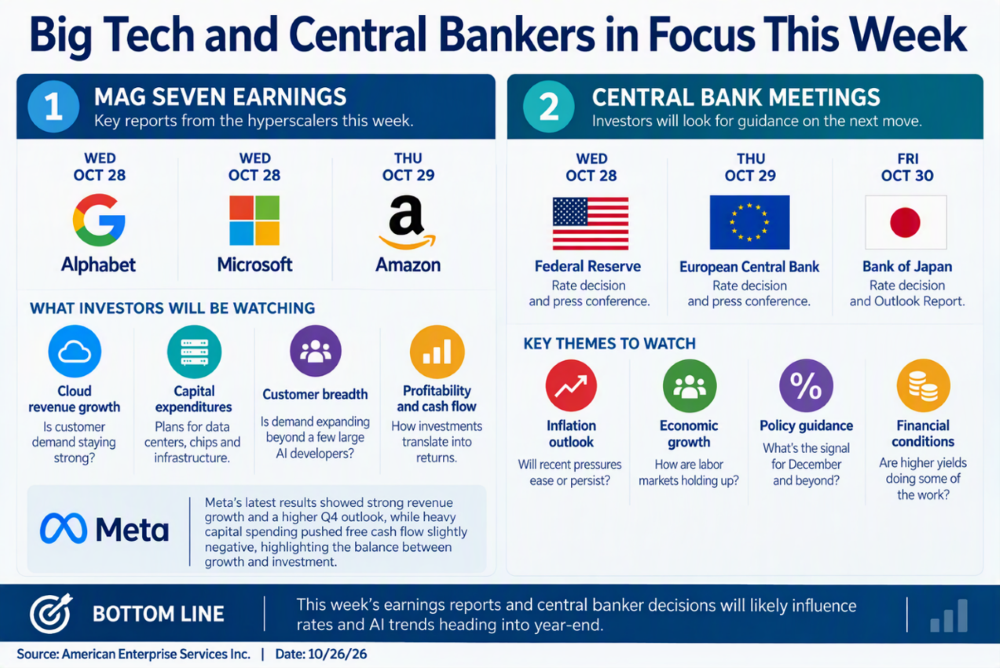
Meta Platforms offered an early example last week of why strong business results and heavy investment need to be assessed together. Its latest report showed strong revenue growth and a fourth-quarter revenue outlook above expectations, while substantial capital spending pushed free cash flow slightly negative. Although parts of Meta’s business differ from that of cloud providers, we believe the investment question applies across the group. Simply, are improvements in the underlying business sufficient to support the next round of AI spending? For Microsoft, Alphabet, and Amazon, investors will look for corporate guidance that connects expected cloud growth with the spending required to deliver it. In our view, management teams may need to explain more directly when new capacity becomes available, when it begins generating revenue, and how those investments affect cash generation and will meet growth estimates.
Bottom line: Healthy cloud growth expectations, well-explained spending plans, and a credible path to stronger cash generation will likely determine whether these reports restore confidence in the AI trade. Yes, building data centers ahead of customer demand can be necessary and is expensive. Nevertheless, investors need confidence that aggressive capex spending reflects durable business needs and that profitability will hold up as new infrastructure comes into service. Evidence of demand among a broader customer base would also likely strengthen that case.
Elevated inflation keeps central bankers focused on rate hikes
In a nutshell, higher oil prices, heavy AI spending, and stubborn inflation are keeping pressure on central banks around the world to consider further rate increases. This week, investors will look to the Federal Reserve, European Central Bank, and Bank of Japan for clues about how much higher borrowing costs could go, even if all three leave rates unchanged, which is expected. The Fed announces its rate decision Wednesday, followed by the ECB on Thursday, and the BOJ on Friday.
Here at home, September’s unemployment rate of 4.2% and headline consumer inflation of +3.7% year over year leave policymakers with limited reason to consider lowering rates. Employment conditions remain relatively steady, while higher energy/input costs have begun to seep into core inflation of late. Continued demand and AI-related investment have also complicated efforts to bring price pressures under control. Following September’s quarter-point rate increase, officials must decide how much additional restraint the economy needs.
Importantly, the Fed’s inflation concerns extend beyond energy. In September, officials raised their 2026 forecast for core Personal Consumption Expenditures (PCE) inflation to +3.4% and lifted their economic growth forecast to +2.3%. Core PCE excludes food and energy and helps policymakers assess underlying price trends. Notably, officials’ projections didn’t show inflation returning to target until 2029. Stronger expected growth alongside persistent inflation helps explain why many policymakers are keeping rate increases under consideration.
As hinted at above, AI spending adds another layer to that decision. Building data centers and expanding computing capacity support economic activity today, while potential productivity benefits develop over time. Several Fed officials have flagged the investment boom as a source of near-term inflation pressure. Of course, higher energy costs add to the challenge, particularly if businesses pass those expenses along to customers. In our view, the Fed will want greater confidence that these pressures are not adding to inflation before concluding that September’s increase was sufficient.
That said, higher Treasury yields are already doing some of the Fed’s work, in our view. More expensive financing is cooling demand for housing and automobiles, giving officials room to assess the effects of September’s rate hike before raising rates again. Investors will listen closely to Chair Kevin Warsh for whether that restraint supports a longer pause or simply allows the committee to wait until December. With no updated economic projections scheduled this week, the statement and press conference will carry added weight.
Europe faces a tougher balance between controlling inflation and protecting growth. Eurozone inflation reached +3.8% year over year in September, while second-quarter economic growth was just +1.2% from a year earlier. Higher energy costs threaten to squeeze household purchasing power and business margins, adding pressure to an economy growing more slowly than the U.S. Several ECB officials continue to favor another rate increase, while others see weaker demand and tighter borrowing conditions as reasons to proceed cautiously.
For the ECB, we believe much depends on whether higher energy prices are passed through to wages and other goods and services. ECB President Christine Lagarde has said officials are not yet seeing meaningful evidence of that broader transmission. Investors will watch for any change in that assessment this week. If policymakers believe businesses will increasingly pass along costs and workers will seek higher wages to offset them, officials could see a stronger case for further tightening despite subdued growth.
French fiscal concerns and rising government bond yields add another wrinkle for the ECB to navigate. Borrowing conditions have already tightened following the ECB’s 25-basis-point rate increase in September, and this, combined with mounting fiscal concerns across Europe, most acutely seen in France, likely reduces the need for immediate action, in our view. Notably, investors will be looking for whether officials place greater emphasis on that restraint, given current conditions, or on the risk that inflation remains elevated.
Finally, the Bank of Japan (BOJ) also meets on Thursday and Friday. Officials are expected to hold their policy rate at 1.25% as they monitor the effects of September’s increase. Notably, the BOJ’s Outlook Report is likely to signal that underlying inflation is now consistent with its +2.0% target. That assessment alone wouldn’t necessarily prompt another rate increase, in our view. Still, it would give officials more room to raise rates if inflation risks build. Thus, we believe a back-to-back BOJ rate increase appears unlikely this week, and board members concerned about a sharp inflation overshoot remain in the minority. In our view, the BOJ’s focus is shifting from reaching its inflation target to sustaining it, which likely keeps further gradual increases on the table into next year.
Bottom line: In our view, an October pause across some of the world’s largest central banks this week will likely still leave additional rate increases firmly under consideration by year-end. As such, we do not see market concerns about rates and inflation changing much after this week’s meetings. That said, their guidance could help fortify expectations for December and help influence the direction of bond yields, stock valuations, and interest rate-sensitive sectors through the rest of the year, at the least.
The Week Ahead:
- September PCE inflation and the first estimate of third-quarter GDP on Thursday are the week's key economic releases. September durable goods orders, October consumer confidence, and new home sales come out Tuesday, and the employment cost index is due Friday.
- Roughly 36% of the S&P 500 will report third quarter results this week, making it the busiest of the season. Verizon reports Monday. Boeing, Coca-Cola, UPS, Visa, and Royal Caribbean follow on Tuesday, and FedEx, Ford, ServiceNow, T-Mobile, and Chipotle report Wednesday.
- Caterpillar, Eli Lilly, Mastercard, D.R. Horton, Intel, and Starbucks report Thursday, followed by AbbVie, Chevron, and General Dynamics on Friday.
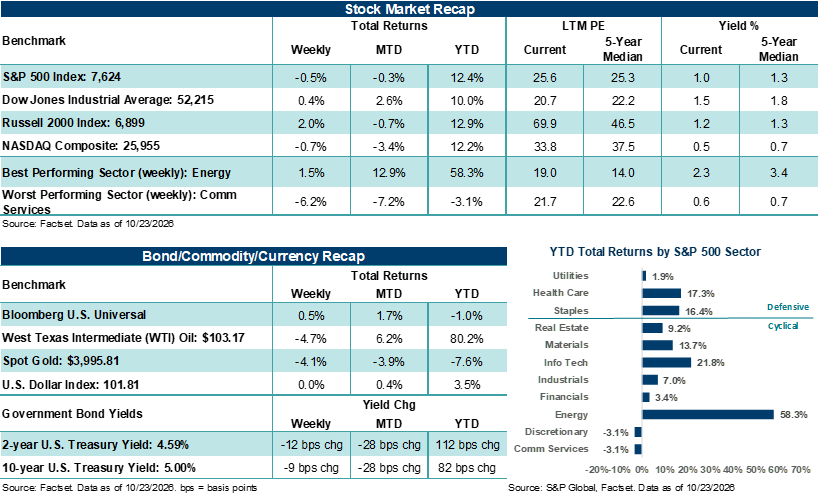
These figures are shown for illustrative purposes only and are not guaranteed. They do not reflect taxes or investment/product fees or expenses, which would reduce the figures shown here. An index is a statistical composite that is not managed. It is not possible to invest directly in an index. Past performance is not a guarantee of future results.
Important Disclosures
Sources: FactSet and Bloomberg. FactSet and Bloomberg are independent investment research companies that compile and provide financial data and analytics to firms and investment professionals such as Ameriprise Financial and its analysts. They are not affiliated with Ameriprise Financial, Inc.
The views expressed are as of the date given, may change as market or other conditions change, and may differ from views expressed by other Ameriprise Financial associates or affiliates. Actual investments or investment decisions made by Ameriprise Financial and its affiliates, whether for its own account or on behalf of clients, will not necessarily reflect the views expressed. This information is not intended to provide investment advice and does not account for individual investor circumstances.
Some of the opinions, conclusions and forward-looking statements are based on an analysis of information compiled from third-party sources. This information has been obtained from sources believed to be reliable, but accuracy and completeness cannot be guaranteed by Ameriprise Financial. It is given for informational purposes only and is not a solicitation to buy or sell the securities mentioned. The information is not intended to be used as the sole basis for investment decisions, nor should it be construed as advice designed to meet the specific needs of an individual investor.
Commodity investments may be affected by the overall market and industry- and commodity-specific factors, and may be more volatile and less liquid than other investments.
There are risks associated with fixed-income investments, including credit (issuer default) risk, interest rate risk, and prepayment and extension risk. In general, bond prices rise when interest rates fall and vice versa. This effect is usually more pronounced for longer term securities.
Investments may not keep pace with inflation, resulting in loss of purchasing power.
Stock investments involve risk, including loss of principal. High-quality stocks may be appropriate for some investment strategies. Ensure that your investment objectives, time horizon and risk tolerance are aligned with investing in stocks, as they can lose value.
The products of technology companies may be subject to severe competition and rapid obsolescence, and their stocks may be subject to greater price fluctuations.
Past performance is not a guarantee of future results.
An index is a statistical composite that is not managed. It is not possible to invest directly in an index.
Definitions of individual indices and sectors mentioned in this article are available on our website at ameriprise.com/legal/disclosures in the Additional Ameriprise research disclosures section.
The S&P 500 Index is a basket of 500 stocks that are considered to be widely held. The S&P 500 index is weighted by market value (shares outstanding times share price), and its performance is thought to be representative of the stock market as a whole. The S&P 500 index was created in 1957 although it has been extrapolated backwards to several decades earlier for performance comparison purposes. This index provides a broad snapshot of the overall US equity market. Over 70% of all US equity value is tracked by the S&P 500. Inclusion in the index is determined by Standard & Poor’s and is based upon their market size, liquidity, and sector.
Equal Weight S&P 500: An index that gives each company in the S&P 500 the same weight, approximately 0.2%, regardless of its market size. This differs from the traditional S&P 500, which weights companies based on their market capitalization, giving larger companies a greater influence on performance. As a result, the Equal Weight S&P 500 generally provides greater exposure to mid-sized companies and reduces concentration in the largest stocks.
The S&P 500 Information Technology Index comprises those companies included in the S&P 500 that are classified as members of the Global Industry Classification Standard (GICS) information technology sector.
The NASDAQ Composite index measures all NASDAQ domestic and international based common type stocks listed on the Nasdaq Stock Market.
The Dow Jones Industrial Average (DJIA) is an index containing stocks of 30 Large-Cap corporations in the United States. The index is owned and maintained by Dow Jones & Company.
The Russell 2000 Index measures the performance of the small-cap segment of the US equity universe. The Russell 2000 is constructed to provide a comprehensive and unbiased small-cap barometer and is completely reconstituted annually to ensure larger stocks do not distort the performance and characteristics of the true small-cap opportunity set. The Russell 2000 includes the smallest 2000 securities in the Russell 3000.
West Texas Intermediate (WTI) is a grade of crude oil commonly used as a benchmark for oil prices. WTI is a light grade with low density and sulfur content.
The US Dollar Index (USDX) indicates the general international value of the USD. The USDX does this by averaging the exchange rates between the USD and major world currencies. This is computed by using rates supplied by approximately 500 banks.
Personal consumption expenditures (PCE) are a measure of the outlays or how much consumers are spending. The PCE reading is released monthly by the Bureau of Economic Analysis.
Core PCE is a measure of inflation that tracks changes in the prices of goods and services purchased by consumers excluding food and energy prices.
Flash PMI is an early estimate of the Purchasing Managers’ Index based on partial survey data collected before the month ends. It provides a timely snapshot of economic activity in the manufacturing and/or services sectors.
The Philadelphia Semiconductor Index (SOX) is a stock market index that tracks the performance of companies in the semiconductor (chip) industry.
University of Michigan Consumer Sentiment Survey is a rotating panel survey based on a nationally representative sample of households in the U.S. that measures how consumers feel about the economy, personal finances, business conditions, and buying conditions.
NVIDIA and third party companies mentioned are not affiliated with Ameriprise Financial, Inc.
Investment products are not insured by the FDIC, NCUA or any federal agency, are not deposits or obligations of, or guaranteed by any financial institution, and involve investment risks including possible loss of principal and fluctuation in value.
Securities offered by Ameriprise Financial Services, LLC. Member FINRA and SIPC.