A little level-setting ahead of a busy week of earnings
ANTHONY SAGLIMBENE – CHIEF MARKET STRATEGIST, AMERIPRISE FINANCIAL
WEEKLY MARKET PERSPECTIVES — July 20, 2026

U.S. stocks finished lower last week, with the S&P 500 Index and NASDAQ Composite snapping back-to-back weekly gains as a sharp selloff in semiconductors and AI-linked names weighed on major indices. This week, second-quarter earnings pick up meaningfully, with Alphabet, Tesla, IBM, Intel, and financial names on deck.
Last week in review:
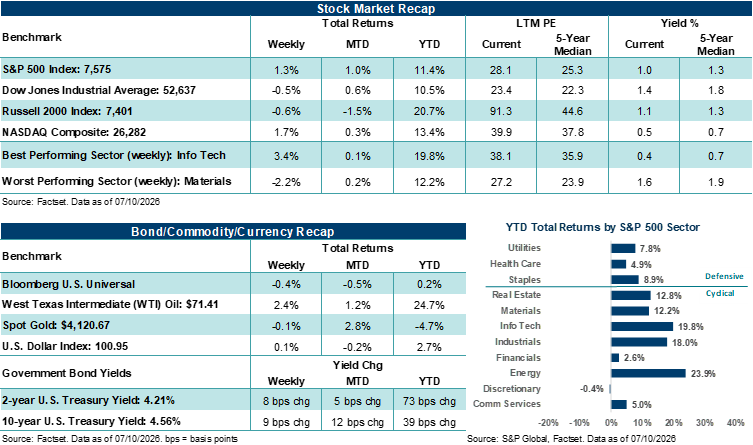
- The S&P 500 Index fell 1.5% last week, the NASDAQ Composite dropped 2.9%, the Dow Jones Industrial Average slipped 0.9%, and the Russell 2000 Index declined 0.5%. The Philadelphia Semiconductor Index fell 10% and closed in bear market territory.
- Treasury prices firmed with some curve steepening. The 2-year Treasury yield fell to 4.18%, the 10-year settled at 4.55%, and the 30-year finished at 5.07%. The U.S. Dollar Index was flat. Gold fell 2.3%, and West Texas Intermediate (WTI) crude rose +13.7%, its biggest weekly gain since April.
- June core CPI was flat month-over-month, and core PPI rose +0.2%, both below consensus. June retail sales beat expectations and preliminary July Michigan consumer sentiment topped estimates, with one-year inflation expectations falling to 4.2%. Fed Chair Kevin Warsh, in his first semiannual testimony to Congress, said there is "still work to do" on inflation despite the cooler prints.
- Second-quarter bank earnings were well received. JPMorgan Chase, Bank of America, Wells Fargo, Citigroup, and Goldman Sachs delivered strong equity trading revenue, solid investment banking fees, and constructive commentary on the consumer. Morgan Stanley also posted strong results.
- Geopolitical tensions escalated again. Multiple rounds of U.S.-Iran strikes and counterstrikes drove oil higher, and Axios reported the U.S. is sending additional refueling planes to Israel ahead of a possible expansion of military operations.
- Last week’s performance was a reminder that the AI trade still drives the market's overall direction, both up and down. Notably, we believe the semiconductor selloff looks more like a positioning unwind after a strong few months of performance rather than a fundamental shift away from the group. And the rotation into banks, energy, and defensives suggests investors are rebalancing rather than exiting the market, which could be a healthy development that allows the market to digest recent gains as Q2 earnings kick into high gear.
“Earnings breadth widened last week, credit quality improved across the major banks, and the macro backdrop supports selective positioning across cyclicals, including Tech, over the summer. That said, positioning is stretched, and the market has shown its unwillingness to pay higher multiples for narratives already reflected in stock prices.”
Anthony Saglimbene - Chief Market Strategist, Ameriprise Financial
A little level-setting ahead of a busy week of earnings
The Q2 earnings season opened last week with historic bank results. This was accompanied by cooler-than-expected inflation data, Fed Chair Kevin Warsh's first testimony to Congress, and a semiconductor selloff that could test investors' fortitude over the coming weeks. As we noted in recent commentary, the two risks to watch over this reporting cycle are how investors respond to concentration risk in the largest AI beneficiaries and the pace of rotation into other parts of the market. Both were on display last week. That said, the S&P 500 held its ground on strong earnings across Financials, while the NASDAQ Composite and the semiconductor complex took larger hits as the market repriced the cost of sustaining the AI buildout. That dynamic will likely bleed into this week amid several days of heavy profit reports from mega-cap tech and financial companies.
Big Banks set a very positive tone to start off the Q2 earnings season
The major U.S. banks delivered one of the strongest quarters in years. Collective profits across the five largest firms rose +39% year-over-year, with combined earnings above $49 billion, according to Bloomberg. If you're keeping score at home: The banking scorecard stood at 10 earnings beats to 0 misses by the end of the week, meaning analysts were too conservative coming into the reports.
For example, JPMorgan Chase posted a record quarterly profit, powered by solid results across equity trading that beat even the highest analyst estimates. CEO Jamie Dimon called the environment "getting close to as good as it gets." Goldman Sachs set another all-time record in equities sales and trading, its third straight quarter doing so, and investment banking revenue moved sharply higher. For its part, Morgan Stanley delivered standout performance across wealth management, prompting a broad wave of analyst target increases.
That said, the less-discussed, more durable signal in last week’s bank earnings ran beneath the trading and capital markets headlines. Notably, every major bank set aside less money for loan losses in Q2. In our view, that’s a direct “positive” read on the U.S. consumer and corporate borrower, and it signals a meaningful benefit for the U.S. economy over the intermediate-term outlook. Simply put, solid credit trends across the big banks last quarter, combined with constructive outlooks for the quarter ahead, could be an important cue into what we see for other non-tech cyclicals as they report over the coming weeks.
And the earnings strength extends beyond the Big Banks
UnitedHealth raised full-year adjusted earnings per share (EPS) guidance meaningfully and delivered Q2 profit results that lifted managed care peers. Abbott Laboratories raised full-year guidance on the back of a broad-based revenue beat. And insurance results were also strong, with Travelers reporting Q2 underwriting profitability well ahead of consensus estimates on a benign catastrophe quarter.
Thus, the market’s price action last week favored a broader equity approach, given the strength in names kicking off the earnings season. Case in point: The equal-weight S&P 500 outperformed the cap-weighted index last week, a pattern largely absent over the last few months as Technology was rallying. Some are framing the current rotation as the mechanism by which the stock rally could broaden further, arguing that sharp sector rotations could become a more prominent feature of a maturing bull market rather than a warning of its end. The jury is still out, in our view, but last week’s price action suggests that early earnings reports could drive more rotation ahead. The catch? The broadening theme really only helps if the rotation stays orderly. What gets rotated out of (say, Tech) has to hold together well enough to keep the broader S&P 500 intact.
Selling pressure continues in semiconductors
On that point, how semiconductors and the broader AI hardware space trade over the next several weeks may help shape broader market sentiment. For example, Taiwan Semiconductor Manufacturing Company (the largest chipmaker in the world) delivered a solid earnings beat for the previous quarter last week, and guided 2026 sales growth higher. But the company also raised full-year capex guidance to a record $60-$64 billion. As a result, the stock sold off. ASML raised its full-year sales outlook for the second time in 2026 and lifted margin guidance. Still, the stock finished the week lower. And IBM's warning that it would miss profit estimates, which it will report this week, saw the stock sell off roughly 25% on the day of the announcement, dragging the broader software complex and AI momentum down as well.
Notably, the Philadelphia Semiconductor Index finished the week in a bear market (i.e., down 20% or more from a recent high) after a nearly +89% rise in the second quarter (so context matters here). Nevertheless, Taiwan's benchmark entered a technical correction last week, and memory and storage stocks worldwide experienced selling pressure. At the highest level, we believe the concern comes down to cost. The market is scrutinizing whether the capex burden required to sustain the AI buildout justifies current multiples, and, in our view, simple earnings beats and guidance raises within Tech likely no longer clear that bar on their own. Finally, here, Chinese AI startup Moonshot's release of its Kimi K3 model on Friday added another headwind (i.e., cheaper large language models) at a moment when positioning was already stretched.
And it’s pretty crowded out there right now
Bank of America’s July fund manager survey showed cash levels at 3.6% of assets, an "uber-low" reading, with U.S. equity positioning at its highest level since December 2024. Long global semiconductors was the most crowded trade for a third straight month, and an AI bubble is now the number one tail risk, with 45% of respondents citing the risk, up from 28% in June. Also, insider selling totaled $77.6 billion in the first half of 2026, up +20% year over year and the second-fastest pace in more than 20 years, according to Bloomberg. Only the pandemic-era 2021 selling was more aggressive. However, none of that, in our view, constitutes a market top call. Yet, it does help explain why Tech is being sold at these levels (positioning like this rarely requires a large catalyst to move stock prices). Thus, we would treat such information as context for how quickly market moves can compound in either direction from here.
Inflation and Warsh help ease near-term rate hikes
June CPI marked the largest decline in inflation in six years, and the PPI release reinforced the cooling trend. However, much of that was due to lower energy prices, which have climbed higher in July. Nevertheless, odds of a July rate hike collapsed last week, and Fed Chair Kevin Warsh's first testimony to Congress helped maintain the dovish repricing. We believe the current inflation, labor, and macroeconomic picture gives policymakers time to hold policy steady through the summer.
What we're watching this week
Tesla, Alphabet, Intel, Texas Instruments, IBM, and ServiceNow all report this week. However, Alphabet will be a key focus in the AI trade. Cloud growth could accelerate above the Street's roughly +65% year-over-year estimate, and the backlog has been trending higher. But capex spend could be the complicating factor. Any upward revision here comes amid an environment that just punished others for the same factor, and a reported delay to Google's flagship Gemini 3.5 Pro model adds an overhang on competitive positioning against Anthropic and OpenAI.
For Texas Instruments, investors will want to see whether demand from industrial customers and data centers held up in Q2 and whether management's outlook for the second half points to lasting trends. For Intel, the focus will be on server chip demand, progress on its next-generation manufacturing technology, and whether profit margins can improve from here despite rising input costs. Strong results and outlooks from both would support the view that last week's selloff in chip stocks was a rotation rather than a broader breakdown in the AI trade. Of course, any signs of slowing demand or margin pressure in these two names would likely extend the recent weakness in semis.
Notably, IBM's formal release this week is the first chance for management to explain last week's preliminary miss that dragged Microsoft, Oracle, Workday, and Salesforce lower. Whether the miss reflects company-specific execution or a broader enterprise IT spending slowdown will be the focus, particularly given that ServiceNow reports the same day and SAP later in the week. Finally, American Express’s report will provide a look at premium-consumer trends, and the consumer credit trio of Synchrony, Ally, and Capital One will show whether the credit quality improvement seen at the major banks extends past prime borrowers.
Bottom line: Earnings breadth widened last week, credit quality improved across the major banks, and the macro backdrop supports selective positioning across cyclicals, including Tech, over the summer. That said, positioning is stretched, and the market has shown its unwillingness to pay higher multiples for narratives already reflected in stock prices. Importantly, the bar for the mega-cap tech names reporting this week has moved from the results themselves to the cost side of the story, and specifically the capex line and its trajectory. Investors should expect a bumpier ride over the next few weeks as the market receives critical updates on how all of this is setting up the second half of the year.
The week ahead:
- July flash S&P Global PMIs on Friday will be a notable macro release, with the Federal Reserve in its blackout period ahead of the July 29th policy decision.
- As mentioned, second-quarter earnings pick up materially this week, with 89 S&P 500 companies scheduled to report. Other notable reports include General Motors, 3M, Northrop Grumman, GE Vernova, AT&T, CSX, Southwest Airlines, Honeywell, Lockheed Martin, Thermo Fisher, American Express, and Verizon.