2026 midterms: How different election results could drive markets
Anthony Saglimbene – Chief Market Strategist, Ameriprise Financial
Sept. 14, 2026

Every two years, politics moves to the center of the national conversation, at least in the months leading up to November. However, in our view, investors rarely need to let that conversation drive their investment decisions.
Since 1945, U.S. stocks have climbed higher under both parties and across nearly every configuration of Washington: Democratic presidents, Republican presidents, unified control of Congress, divided control. Through it all, the long-term direction of the stock market has generally been higher. In our view, that’s the anchor investors should center on as a barrage of political campaign commercials hits the airwaves this fall.
That said, history provides some interesting election insights for markets. Below, we explore how the 2026 election could influence market sectors and what past midterm cycles may suggest about the road ahead for investors.
Explore how markets and the economy have historically performed under different political environments and election cycles.
What financial issues will be at the forefront?
What separates this year's midterm election from a typical cycle is that several of the economy's most important pressure points sit at the intersection of politics, consumer sentiment and financial markets. As a result, some issues are likely to shape how Americans vote, while others may have an outsized influence on investors, corporations and stock prices.
Voters and consumers
Affordability, particularly around everyday expenses and energy costs, is likely to remain front and center for voters heading into Election Day:
-
Prices and the cost of living: The broadest visible economic concern today and, in our view, the issue most likely to influence voter sentiment and turnout.
-
Energy costs: A geopolitical risk premium on oil tied to Middle East tensions has kept gasoline prices in focus since late February. Because fuel costs are a regular household expense, they often carry outsized influence on voters' perceptions of the economy.
-
Health care and housing: Rising costs in both areas remain recurring concerns and are closely tied to broader affordability challenges facing many households.
-
Jobs and the labor market: Hiring trends, wage growth and perceptions of job security all play an important role in shaping consumer confidence and economic sentiment.
Investors and corporations
While voters tend to focus on affordability issues, investors and corporate leaders are often more concerned with policy decisions that can influence earnings, capital spending and economic growth:
-
Tariffs and trade policy: Trade policy has remained in near-constant flux throughout President Trump's second term and continues to influence corporate investment decisions, supply-chain strategies and inflation expectations. New tariff measures, sector-specific levies and ongoing negotiations with major trading partners have kept policy uncertainty elevated.
-
Regulatory policy: Potential shifts in regulation could have implications for sectors such as energy, financials, health care and technology, depending on the election outcome.
-
Business investment and capital spending: Companies continue to evaluate hiring plans, infrastructure investments and long-term growth initiatives against an evolving policy backdrop.
-
Corporate profit outlooks: Ultimately, investors are likely to stay focused on how election outcomes and policy decisions may affect earnings growth, which has historically been a more important driver of stock returns than politics alone.
As the 2026 U.S. midterm elections approach, Ameriprise Financial experts share their perspectives on how the results may influence the broader market, economy and investments. (7:23)
How the 2026 midterms may shape sector leadership
The six months before a midterm election have historically been choppy, producing mixed performance across sectors. However, the twelve months following a midterm have tended to reward sectors that are growth/cyclically orientated. For example, information technology has led post-election gains, followed by consumer discretionary and communication services, while defensives and financials (while positive) tend to trail post-election.
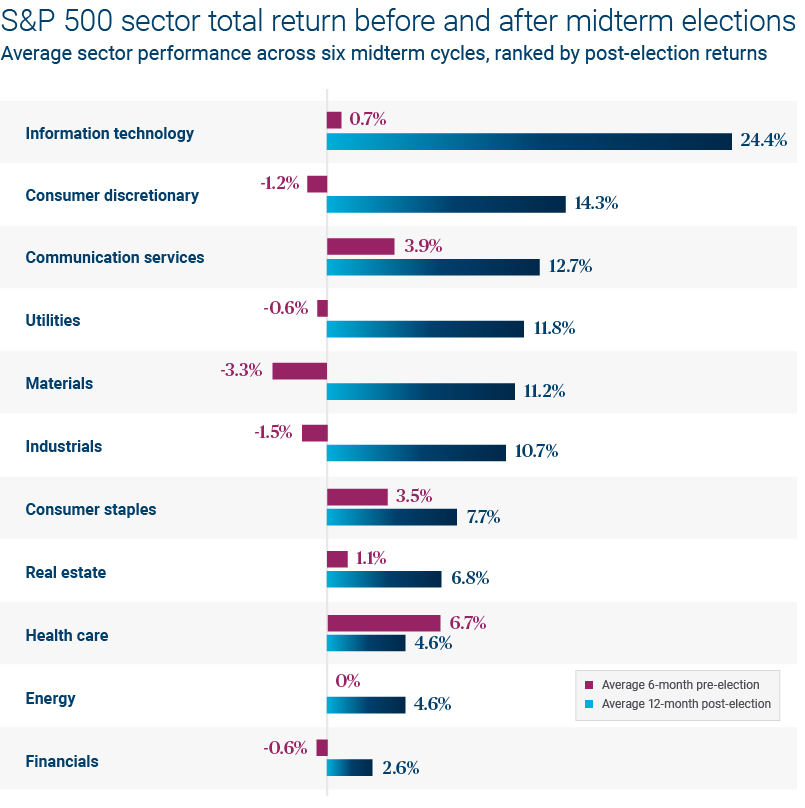
Sources: Bloomberg, American Enterprise Investment Services Inc. Data includes midterm years 2002, 2006, 2010, 2014, 2018 and 2022. Total returns cover exact 6-month pre-election and 12-month post-election windows anchored to each midterm election date. Average are simple means across the six cycles. This example is shown for illustrative purposes only and is not guaranteed. Past performance is not a guarantee of future results. An index is a statistical composite that is not managed. It is not possible to invest directly in an index.
Here’s how different sectors could perform depending on this November’s election outcomes:
-
Split Congress: Currently, many political watchers and prediction markets are pointing to a split Congress as the base case for this election cycle. And as history suggests, split governments tend to produce a solid backdrop for stocks post-election, since gridlock limits sweeping policy change over the next two years. In our view, that backdrop favors the sectors already leading in 2026, such as technology, which is directly tied to the AI spending cycle, and industrials, supported by bipartisan defense and infrastructure outlays.
-
Republican control: If Republicans maintain control of Congress, the energy and financials sectors could benefit from a policy environment that emphasizes deregulation and business-friendly initiatives. Traditional energy producers, banks and capital markets firms may be among the sectors most likely to see favorable sentiment under this scenario.
-
Democratic control: A Democratic sweep of the House and Senate could shift investor attention toward sectors aligned with government spending priorities and energy transition initiatives. At the same time, traditional energy companies, pharmaceutical manufacturers and some large technology firms could face increased regulatory scrutiny relative to other sectors.
Learn more: What to expect from markets during a midterm election year
What investors can learn from past midterms
History provides some interesting insights for markets during election years:
Markets have generally performed well during the second year of a president's second term.
This year’s midterm election comes in the president’s second term. And based on average S&P 500 Index returns since 1945, the second year of a second-term president has actually been one of the firmer stretches of the presidential cycle, averaging +20.4%. In some respects, that runs counter to the familiar reputation for weak stock performance during mid-term years, which is drawn mostly from a president’s first term. Case in point: the S&P 500 Index is up nearly +12.3% year-to-date through the end of August.
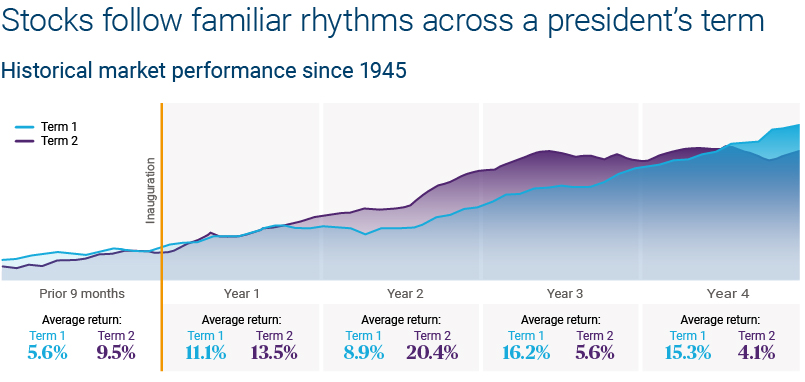
Sources: Bloomberg, S&P Dow Jones Indices. Calculations based on monthly price-return data of the S&P 500 Index and are averaged for each presidential administration during the term that president served, based on monthly observations. Presidential terms are rounded to the nearest month based on the day the president enters and exits office. Not all presidents finish their entire term; not all presidents serve a second term. Data as of 4/30/2026, beginning in April 1945. For illustrative purposes only and is not guaranteed. Past performance is not a guarantee of future results. An index is a statistical composite that is not managed. It is not possible to invest directly in an index.
Economic and market fundamentals have historically mattered more than election politics.
Softer midterm election years tend to have an underlying cause that typically has little to do with Washington politics. For example, the 2018 and 2022 declines in the S&P 500 tracked Federal Reserve rate hikes and other macroeconomic issues of the day. And the 2002 drop in the Index reflected the unwinding of the technology bubble more than any other issue. In fact, some midterm election years see very strong S&P 500 returns (as the chart below shows), with weaker midterm averages overall usually pulled down by large drawdowns unrelated to the midterm election itself.
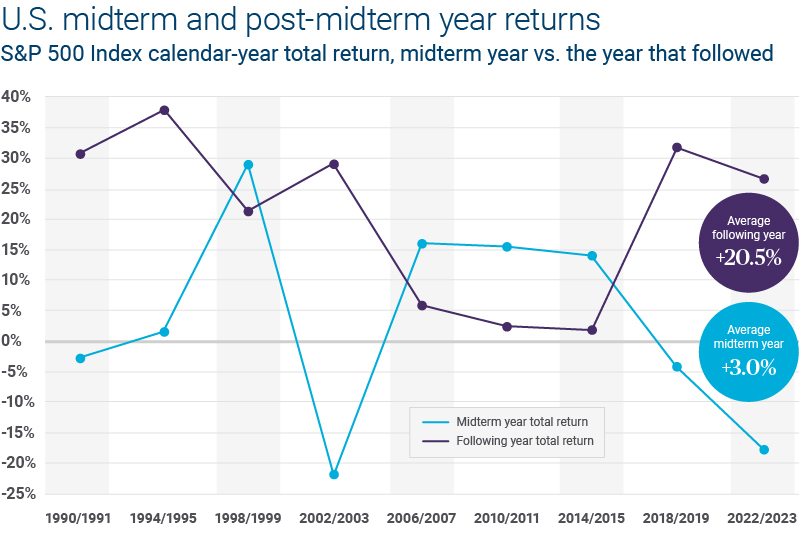
Sources: Bloomberg, S&P Dow Jones Indices, and American Enterprise Investment Services, Inc. Total returns include reinvested dividends. This example is shown for illustrative purposes only and is not guaranteed. Past performance is not a guarantee of future results. An index is a statistical composite that is not managed. It is not possible to invest directly in an index.
Markets have historically strengthened after midterm elections.
Historically, while the S&P 500 has delivered muted returns on average heading into a midterm election, returns following the results have tended to be strong. On average, the S&P 500 gains +8.8% three months after a midterm, +15.9% at six months, and +20.1% nine months out, going back to 1946. And in the year following a midterm election, the S&P 500 has gained an average of +20.5% since 1990.
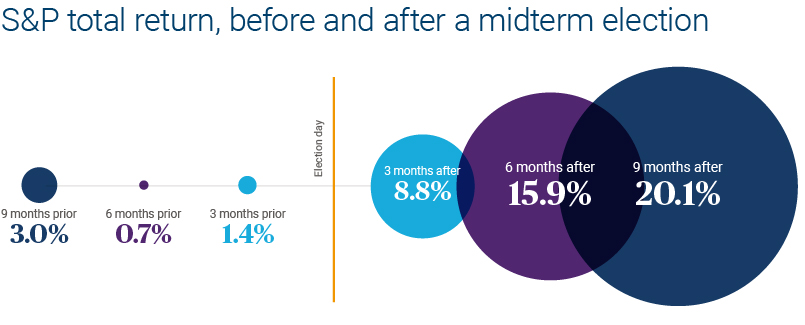
Sources: Bloomberg, S&P Dow Jones Indices. Data based on calendar months beginning in 1946. Since we do not have pre- and post-2026 midterms data, this data includes midterms up through 2022. For illustrative purposes only and is not guaranteed. Past performance is not a guarantee of future results. An index is a statistical composite that is not managed. It is not possible to invest directly in an index.
History can provide perspective, but it doesn't guarantee future results.
Historical trends have occasionally been overshadowed by major economic and financial shocks. For example, 2007 sat on the edge of the global financial crisis. And 2011 collided with Europe's debt crisis. Thus, the historical patterns described above are tendencies, not rules, and a sufficiently large market/economic shock can override historical trends pretty easily.
Bottom line
Stock volatility may build as November nears, as investors attempt to discount election results in advance. However, we believe maintaining a long-term perspective is often more important than reacting to election headlines. If economic and corporate profit fundamentals remain firm, periods of election-related market weakness, should they occur, may present opportunities for long-term investors willing to look beyond the near-term political noise.
Don’t let election uncertainty sway your portfolio
As the election approaches, know that your Ameriprise financial advisor can help you cut through the noise and focus on the factors that matter most to your long-term financial success.
One of your clients has some questions they would like to discuss with you at your next meeting.
warning Something went wrong. Do you want to try reloading? Try again
When you’re ready to reach out to an Ameriprise financial advisor for a complimentary initial consultation, consider bringing these questions to your meeting.
Reach out to %advisor% to start the conversation.
Or, request an appointment online to speak with an advisor.
At Ameriprise, the financial advice we give each of our clients is personalized, based on your goals and no one else's.
If you know someone who could benefit from a conversation, please refer me.
Background and qualification information is available at FINRA's BrokerCheck website.
The initial consultation provides an overview of financial planning concepts. You will not receive written analysis and/or recommendations.
The views expressed are as of the date given, may change as market or other conditions change, and may differ from views expressed by other Ameriprise Financial associates or affiliates. Actual investments or investment decisions made by Ameriprise Financial and its affiliates, whether for its own account or on behalf of clients, will not necessarily reflect the views expressed. This information is not intended to provide investment advice and does not account for individual investor circumstances.
Some of the opinions, conclusions and forward-looking statements are based on an analysis of information compiled from third-party sources. This information has been obtained from sources believed to be reliable, but accuracy and completeness cannot be guaranteed by Ameriprise Financial. It is given for informational purposes only and is not a solicitation to buy or sell the securities mentioned. There is no guarantee that investment objectives will be achieved or that any particular investment will be profitable.
The information is not intended to be used as the sole basis for investment decisions, nor should it be construed as advice designed to meet the specific needs of an individual investor.
Stock investments involve risk, including loss of principal. High-quality stocks may be appropriate for some investment strategies. Ensure that your investment objectives, time horizon and risk tolerance are aligned with investing in stocks, as they can lose value.
The products of technology companies may be subject to severe competition and rapid obsolescence, and their stocks may be subject to greater price fluctuations.
Past performance is not a guarantee of future results.
An index is a statistical composite that is not managed. It is not possible to invest directly in an index.
Definitions of individual indices and sectors mentioned in this article are available on our website at ameriprise.com/legal/disclosures in the Additional Ameriprise research disclosures section.
The S&P 500 Index is a basket of 500 stocks that are considered to be widely held. The S&P 500 index is weighted by market value (shares outstanding times share price), and its performance is thought to be representative of the stock market as a whole. The S&P 500 index was created in 1957 although it has been extrapolated backwards to several decades earlier for performance comparison purposes. This index provides a broad snapshot of the overall US equity market. Over 70% of all US equity value is tracked by the S&P 500. Inclusion in the index is determined by Standard & Poor’s and is based upon their market size, liquidity, and sector.
The S&P 500 Total Return Index, calculated intraday by S&P based on the price changes and reinvested dividends of the S&P 500 Index with a starting date of 01/04/1988.
Investment products are not insured by the FDIC, NCUA or any federal agency, are not deposits or obligations of, or guaranteed by any financial institution, and involve investment risks including possible loss of principal and fluctuation in value.
Securities offered by Ameriprise Financial Services, LLC. Member FINRA and SIPC.