Will NVIDIA and Anthropic come to the rescue or throw more cold water on the AI trade?
ANTHONY SAGLIMBENE – CHIEF MARKET STRATEGIST, AMERIPRISE FINANCIAL
WEEKLY MARKET PERSPECTIVES — November 16, 2026

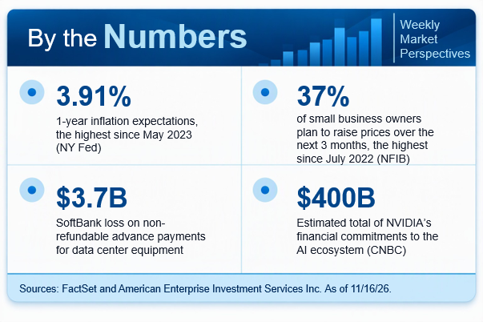
U.S. stocks moved higher last week. AI-related stocks recovered part of the prior week's losses, even as NVIDIA fell sharply following CEO Jensen Huang's resignation. This week, NVIDIA's earnings report and Anthropic's expected IPO will be in focus.
Last week in review:
- The S&P 500 Index rose +2.5% last week, the NASDAQ Composite gained +2.3%, the Dow Jones Industrial Average added +2.1%, and the Russell 2000 Index rose +1.4%. The Philadelphia Semiconductor Index gained +8.1%. Energy, Industrials, and Communication Services led sector performance.
- Treasury yields rose sharply across the curve in their biggest weekly increase since April 2025. The 2-year yield climbed roughly 36 basis points, and the 10-year yield ended the week at 5.15%. The U.S. Dollar Index rose +1.1% to near a 19-month high. Gold fell 4.6%. West Texas Intermediate (WTI) crude declined 6.3% for its second straight weekly drop and settled below $90 per barrel.
- NVIDIA fell 12.8% after CEO Jensen Huang resigned. Investors focused on governance and succession disruptions, and on what his departure could mean for funding at the emerging AI companies he helped finance. NVIDIA reportedly approached Arm CEO Rene Haas as a potential replacement. Notably, retail investors bought heavily into the decline, and AMD and Broadcom, for example, saw their stocks advance higher on the week.
- Inflation data kept pressure on the Federal Reserve to raise rates. October core CPI rose +0.3% month over month for a third straight month, and price increases spread across more categories. October core PPI also rose +0.3%, in line with expectations. Notably, Fed Governor Waller raised the possibility of a 50-basis-point hike in December. As such, markets are pricing in roughly a 92% chance of a 25-basis-point hike at that meeting.
“Interestingly, investors will be able to assess this week both the outlook for the leading supplier of AI chips and, for the first time, establish a public valuation for one of the largest AI businesses on the planet that uses that computing power.”
Anthony Saglimbene - Chief Market Strategist, Ameriprise Financial
Will NVIDIA and Anthropic come to the rescue or throw more cold water on the AI trade?
Since about mid-October, technology stocks have had a rough go of it. The S&P 500 Information Technology Index is down roughly 10% over the last month, the NASDAQ Composite has fallen 6.0%, and the semiconductor sector has declined by over 13%. Notably, the NASDAQ Composite and NASDAQ 100 Index have moved in and out of correction territory, while the Philadelphia Semiconductor Index is down more than 30% from its June high and is firmly in a bear market.
At the same time, investors have become more defensive over recent weeks amid increasing tech volatility. For example, Healthcare (+8.5%) and Consumer Staples (+7.6%) have outperformed over the last month and meaningfully outperformed technology and other economically sensitive sectors as investors look to more defensive areas of the market for protection against AI-driven volatility.
In our view, current market conditions leave NVIDIA’s earnings and Anthropic’s expected initial public offering (IPO) this week arriving at a very sensitive moment. How investors view NVIDIA’s updates against the recent turmoil left in the wake of Jensen Huang’s departure and the market reaction to Anthropic becoming a public company may determine whether the AI trade can gain its footing or whether hiccups here cause further damage across the ecosystem.
NVIDIA will report its highly anticipated profit results on Tuesday. Bloomberg consensus calls for quarterly revenue near $109 billion (+91% year-over-year), followed by approximately $124.5 billion (+83% year-over-year) in the next quarter. A strong quarter of results could help remind investors that NVIDIA’s customers are spending on AI and that demand for its chips and hardware, by any measurable standard, remains incredibly robust. However, as is the case with every earnings release, especially for NVIDIA at this moment, we believe the company’s outlook will carry the most weight. Expect investors to watch closely what interim CEO Colette Kress, who has been the company’s CFO for 13 years, says about the company's direction now that its founder and AI industry leader is no longer steering the ship.
Notably, investors seem to expect next-quarter revenue guidance to meet and probably exceed the consensus, alongside management commentary supporting continued growth into 2027. Analysts will look for results and outlooks that show whether major cloud customers are maintaining orders and delivery schedules, and whether financing or power constraints are delaying purchases by smaller customers (e.g., neoclouds). On Vera Rubin, investors will want updates on production, complete-system shipments, and any bottlenecks affecting deliveries. Management’s explanation of changes in order timing will be particularly important. A strong outlook, supported by firm customer commitments and dependable delivery schedules, could reassure a market that has grown increasingly skeptical about the pace of the AI buildout.
In addition, investors expect NVIDIA’s gross margin to remain near the mid-70% range and will focus on whether the company’s next-quarter outlook points to greater pressure from rising costs. Management will need to explain how higher memory, manufacturing, and packaging costs affect profitability, and whether Rubin pricing and production efficiencies can offset those increases. In our view, a clear explanation of cost pressures and the measures addressing them will also play into how the stock reacts post-results.
Most importantly, Kress must explain how NVIDIA will manage product development, customer relationships, and financial commitments while the board searches for a permanent successor. She will also need to convince investors the company can execute as planned amid what is likely to be an extended period of investigations and potential legal battles. The weight of these new dynamics is just beginning and is likely to create unexpected friction for the company moving forward.
Of course, Huang’s departure raises immediate concerns about talent retention, competition, and financing, even as demand for AI computing remains strong. We believe NVIDIA’s engineering expertise and software advantages remain substantial, though maintaining that lead requires consistent execution as large cloud providers develop alternatives to its key AI chips (think Alphabet’s TPU and Amazon’s Trainium chips).
However, the more pressing concern, in our view, is whether new leadership tightens the financial support NVIDIA provides to customers and partners. Lenders are already demanding greater protections as rates have climbed higher and risks have grown, and some smaller computing providers still need funding to deliver on ambitious AI commitments. In some ways, Huang was the glue holding the AI ecosystem together, especially around the complex financing commitments among neclouds. A more cautious approach from the next CEO could reduce NVIDIA’s financial exposure while possibly delaying customer projects, equipment orders, and data-center construction. Oh, and that’s in addition to what a Democratic government at both the federal and state levels chose to do next year about future data center construction.
Heading into 2027, we believe investors will increasingly judge the AI expansion by whether projects have the financing, power, and paying customers needed to generate attractive returns. NVIDIA’s updates this week will provide some important glimpses into how those trends are playing out, amid a company that could face further stress and disruptions to its leadership and focus.
If NVIDIA’s results weren’t enough for you this week, Anthropic, the developer of Claude, is expected to price its IPO on Wednesday. The company plans to list on the NASDAQ under the ticker “ANT”. According to Bloomberg, the proposed offering values Anthropic near $1.4 trillion at the upper end of its price range, alongside a $26 billion private placement supported by industry partners.
Interestingly, investors will be able to assess this week both the outlook for the leading supplier of AI chips and, for the first time, establish a public valuation for one of the largest AI businesses on the planet that uses that computing power.
Anthropic’s S-1 filing illustrates how quickly commercial AI adoption has expanded. Revenue increased from $4.6 billion in 2025 to $33.2 billion in the first nine months of 2026. Its customer base includes every Fortune 10 company and more than half of the Fortune 500. To some extent, that reach gives investors evidence that businesses are incorporating AI into their operations. More importantly, over time, investors will want clear evidence (through Anthropic’s upcoming earnings reports) of whether those relationships can produce sustained spending and improving profitability to justify the company’s spending commitments, which amount to a staggering $900 billion stretching out to 2045.
For the broader market, we believe the immediate test is whether investors will commit substantial new capital to Anthropic after weeks of falling technology shares. Bloomberg reported the IPO was approximately six times oversubscribed last week. For the AI bulls, that’s an encouraging sign, particularly against weeks of tech volatility. Yet strong demand can also encourage a higher offering price, leaving less room for disappointment in the weeks and months ahead. In our view, raising capital on attractive terms and maintaining investor support once trading begins, as well as in the coming weeks, could provide a convincing confidence boost for both Anthropic and the AI trade.
Notably, the proceeds Anthropic raises this week will help finance spending that supports revenue elsewhere in the AI ecosystem. Anthropic buys computing services from providers that, in turn, purchase chips, networking equipment, and data-center infrastructure. A successful offering would likely broaden the capital supporting the AI supply chain and reduce some near-term uncertainty around its expansion. Conversely, difficult pricing or weaker-than-expected trading could make investors more demanding of the valuations and financing terms offered to other AI companies. The consequences could extend well beyond Anthropic’s share price, in our view. This is what the AI bears are concerned about.
Interestingly, NVIDIA’s approximately $10 billion commitment to Anthropic’s private placement (along with other key AI players) makes the two’s connection particularly relevant this week. Investors will hear NVIDIA’s outlook before Anthropic’s expected pricing, giving them an opportunity to assess both equipment demand and the financial support behind it. We believe confirming existing commitments would help ensure continuity following Huang’s departure. But any hint of a change in NVIDIA’s willingness to finance customers and partners (e.g., pulling or reducing its private placement in Anthropic this week) could translate into a shift in sentiment ahead of Anthropic’s IPO.
Simply, we believe Anthropic’s IPO is a confidence test coming at a time when the AI theme is desperately searching for a positive catalyst. After weeks of losses, investors need a convincing reason to commit fresh capital to the theme rather than use the next near-term rally to reduce exposure to tech.
Bottom Line: A well-received offering this week could encourage buyers to reconsider companies caught up in the recent selling pressure, particularly where earnings prospects remain strong. We believe the more convincing market signal would be sustained interest beyond Anthropic, with investors becoming more comfortable owning the businesses supporting AI’s expansion, particularly if NVIDIA can convince investors its business remains on track amid a leadership void. Conversely, a disappointing reception to both NVIDIA’s report and Anthropic’s IPO could quickly reinforce reluctance to fund ambitious AI growth plans until profits become more dependable. In our view, NVIDIA and Anthropic will help establish whether investors are prepared to look through the current uncertainty or help reinforce why the trade has stalled and possibly accelerate further selling pressure across the tech complex into year-end.
Buckle up, it could be another wild week in the market.
The week ahead:
- October retail sales are out Tuesday and the FOMC meeting minutes on Wednesday, with final November University of Michigan consumer sentiment due on Friday.
- Retail earnings will play in the background, with Home Depot on Tuesday, Lowe's, Target, and TJX Companies on Wednesday, and Walmart and Ross Stores on Thursday.
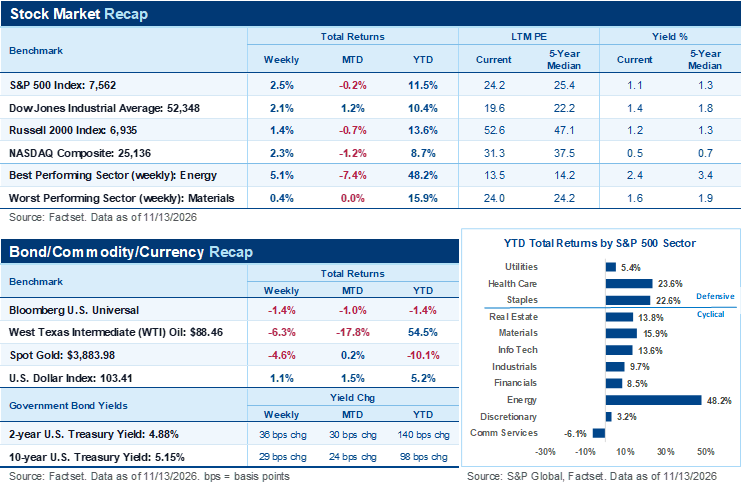
These figures are shown for illustrative purposes only and are not guaranteed. They do not reflect taxes or investment/product fees or expenses, which would reduce the figures shown here. An index is a statistical composite that is not managed. It is not possible to invest directly in an index. Past performance is not a guarantee of future results.
Important Disclosures
Sources: FactSet and Bloomberg. FactSet and Bloomberg are independent investment research companies that compile and provide financial data and analytics to firms and investment professionals such as Ameriprise Financial and its analysts. They are not affiliated with Ameriprise Financial, Inc.
The views expressed are as of the date given, may change as market or other conditions change, and may differ from views expressed by other Ameriprise Financial associates or affiliates. Actual investments or investment decisions made by Ameriprise Financial and its affiliates, whether for its own account or on behalf of clients, will not necessarily reflect the views expressed. This information is not intended to provide investment advice and does not account for individual investor circumstances.
Some of the opinions, conclusions and forward-looking statements are based on an analysis of information compiled from third-party sources. This information has been obtained from sources believed to be reliable, but accuracy and completeness cannot be guaranteed by Ameriprise Financial. It is given for informational purposes only and is not a solicitation to buy or sell the securities mentioned. The information is not intended to be used as the sole basis for investment decisions, nor should it be construed as advice designed to meet the specific needs of an individual investor.
Portfolios that hold a limited number of securities or concentrate investments in similar industries, sectors or geographical regions may experience greater volatility and greater risk of loss as the performance of these investments (either positive or negative) will have a greater impact on the portfolio as a whole.
Diversification does not assure a profit or protect against loss.
There are risks associated with fixed-income investments, including credit (issuer default) risk, interest rate risk, and prepayment and extension risk. In general, bond prices rise when interest rates fall and vice versa. This effect is usually more pronounced for longer term securities.
Stock investments involve risk, including loss of principal. High-quality stocks may be appropriate for some investment strategies. Ensure that your investment objectives, time horizon and risk tolerance are aligned with investing in stocks, as they can lose value.
Investments in small cap companies involve risks and volatility greater than investments in larger, more established companies.
Generally, large-cap companies are more mature and have limited growth potential compared to smaller companies. In addition, large companies may not be able to adapt as easily to changing market conditions, potentially resulting in lower overall performance compared to the broader securities markets during different market cycles
The products of technology companies may be subject to severe competition and rapid obsolescence, and their stocks may be subject to greater price fluctuations.
Past performance is not a guarantee of future results.
An index is a statistical composite that is not managed. It is not possible to invest directly in an index.
Definitions of individual indices and sectors mentioned in this article are available on our website at ameriprise.com/legal/disclosures in the Additional Ameriprise research disclosures section.
The S&P 500 Index is a basket of 500 stocks that are considered to be widely held. The S&P 500 index is weighted by market value (shares outstanding times share price), and its performance is thought to be representative of the stock market as a whole. The S&P 500 index was created in 1957 although it has been extrapolated backwards to several decades earlier for performance comparison purposes. This index provides a broad snapshot of the overall US equity market. Over 70% of all US equity value is tracked by the S&P 500. Inclusion in the index is determined by Standard & Poor’s and is based upon their market size, liquidity, and sector.
The S&P 500 Information Technology Index comprises those companies included in the S&P 500 that are classified as members of the Global Industry Classification Standard (GICS) information technology sector.
The NASDAQ Composite index measures all NASDAQ domestic and international based common type stocks listed on the Nasdaq Stock Market.
The Dow Jones Industrial Average (DJIA) is an index containing stocks of 30 Large-Cap corporations in the United States. The index is owned and maintained by Dow Jones & Company.
The Russell 2000 Index measures the performance of the small-cap segment of the US equity universe. The Russell 2000 is constructed to provide a comprehensive and unbiased small-cap barometer and is completely reconstituted annually to ensure larger stocks do not distort the performance and characteristics of the true small-cap opportunity set. The Russell 2000 includes the largest 2000 securities in the Russell 3000.
The US Dollar Index (USDX) indicates the general international value of the USD. The USDX does this by averaging the exchange rates between the USD and major world currencies. This is computed by using rates supplied by approximately 500 banks.
West Texas Intermediate (WTI) is a grade of crude oil commonly used as a benchmark for oil prices. WTI is a light grade with low density and sulfur content.
The Philadelphia Semiconductor Index (SOX) is a stock market index that tracks the performance of companies in the semiconductor (chip) industry.
Third party companies mentioned are not affiliated with Ameriprise Financial, Inc.
Investment products are not insured by the FDIC, NCUA or any federal agency, are not deposits or obligations of, or guaranteed by any financial institution, and involve investment risks including possible loss of principal and fluctuation in value.
Securities offered by Ameriprise Financial Services, LLC. Member FINRA and SIPC.
© 2026 Ameriprise Financial, Inc. All rights reserved.