Investors should start thinking beyond just “buy the dip”
ANTHONY SAGLIMBENE – CHIEF MARKET STRATEGIST, AMERIPRISE FINANCIAL
WEEKLY MARKET PERSPECTIVES — November 9, 2026

U.S. stocks fell last week amid volatile trading, as a post-midterm rally on Wednesday reversed into a sharp sell-off on Thursday, led by AI-related stocks. This week, October CPI and PPI headline the economic calendar.
Last week in review:
- The S&P 500 Index fell 2.7%, the NASDAQ Composite dropped 3.4%, the Russell 2000 Index declined 2.1%, and the Dow Jones Industrial Average slipped around 1.0%. Consumer Discretionary (+2.7%) and Communication Services(+2.3%) led, while Energy (-12%) and Technology (-6.9%) lagged.
- Treasury yields moved lower, with the 10-year yield ending the week at 4.86%. The U.S. Dollar Index rose +0.4%. Gold gained +5.0%, and West Texas Intermediate (WTI) crude fell 15.5%, its largest weekly decline since April.
- The U.S. midterm election results drove a sharp swing in investor sentiment. Stocks rallied Wednesday after Democrats won control of Congress, creating a divided government. Many investors viewed the outcome as a clearing event and leaned on the historically strong performance of stocks after midterm elections.
- However, AI stocks drove Thursday's reversal. Investors worried that Democratic wins in key data center states, including Texas, could slow the infrastructure buildout. The S&P 500 and NASDAQ posted their worst day since April 2025, and the Philadelphia Semiconductor Index fell 12.2% for the week. Sentiment improved Friday after Texas's governor-elect made supportive comments about data center development.
- The October employment report came in much stronger than expected. Nonfarm payrolls rose +165,000, well above the +65,000 consensus, and September was revised up to +60,000 from +29,000 previously. The unemployment rate fell to 4.1%, and average hourly earnings rose +0.4% month over month.
“We believe resets in expectations are healthy, and the AI trade appears to be working through a reset of its own at the moment. The bullish view is that this helps release some air out of the AI bubble and allows reality and expectations to more closely align, which could keep the bull market charging higher for longer.”
Anthony Saglimbene - Chief Market Strategist, Ameriprise Financial
Investors should start thinking beyond just “buy the dip”
Last week’s volatility and Thursday’s sharp stock declines give investors another reminder of how quickly stocks can lose ground. In some cases, AI-related shares have faced severe selling pressure over the last month, while Consumer Staples, Healthcare, and Utilities have climbed higher. Of course, the concerns behind the selling pressure across Information Technology and AI stocks have been around for months. Simply, elevated interest rates this year make ambitious investment plans more expensive. And while AI spending continues to grow, investors increasingly want assurance that it will generate sufficient revenue and profits to justify the cost. In our view, last week’s U.S. election results, in which Democrats won sweeping control of Congress as well as several key state and local governments, may have accelerated some investors' decisions to reduce exposure to existing AI risks. Although investors can debate a concern for months, unexpected catalysts (such as a sweeping election victory by one party) can prompt investors to act in unison when an event gives them a reason to reconsider how much risk they want to carry into uncertain outcomes.
In our view, new political dynamics are now compounding existing questions about future returns on AI investment. We believe the changing makeup of Washington and state and local governments raises uncertainty around permitting, electricity costs, and construction timelines for future AI data centers. AI projects still awaiting approval or construction appear particularly exposed. Delays could defer equipment orders and customer revenue while extending financing costs. Yes, demand for AI computing can remain strong through those changes. However, investors must now assess how much revenue arrives, when it arrives, and what it costs to deliver that growth. Over the coming quarters, the critical test is whether policy concerns translate into revised project schedules, spending plans, and earnings expectations. Simply put, the body of that evidence will likely determine whether the AI trade can regain its footing or further declines are ahead.
As Thursday’s sharp declines made clear, changes in sentiment or expected conditions can leave little time for investors to adjust. Whether last week’s volatility is a blip or a sign of further volatility ahead, we believe investors should be prepared for a range of outcomes next year.
It’s worth noting that market declines can unfold over years, while others can take just weeks. For example, during the dotcom bust, the S&P 500 Index fell roughly 49% over 927 calendar days. The financial crisis produced a roughly 57% decline over 517 days. Yet, the COVID-19 bear market saw the Index fall roughly 34% in just 33 days. And the tariff tantrum in April 2025 saw the S&P 500 fall almost 20% from its high in just 48 days. During the dotcom bust, investors were working through excessive valuations, disappointing profits, and overinvestment in telecom infrastructure. During the financial crisis, each new loss raised questions about which financial institutions would see further stress and whether credit would remain available. And as most reading this are fully aware, COVID-19 abruptly shut down economic activity without a clear timetable for reopening, while the White House in 2025 introduced extreme tariff policies that were quickly reversed, which, in our view, is why the 2025 decline didn’t unfold into an official bear market.
Nevertheless, modern markets can still experience a prolonged decline. In 2022, the S&P 500 fell approximately 25% over 282 calendar days. In our view, the Fed’s clearly defined task of systematically bringing down inflation helps explain why the market adjustment took longer. Inflation was too high, and higher policy rates were intended to bring it down. Each inflation report and Fed meeting gave investors another opportunity to assess conditions. Here, markets understood the objective. Yet investors still had to determine how high rates would rise, how long they would remain elevated, and how much damage tighter policy would inflict on growth and profits.
At the end of the day, markets are always reacting to new information. Unexpected shocks can quickly cause markets to reset and, in some cases, overshoot to the downside (maybe last week was an overreaction). Other times, longer-established themes need to be reset, or conditions change enough that investors are no longer willing to give stocks the benefit of the doubt. Here, declines take time to develop as the air is slowly released from the momentum that carried stocks higher over the previous cycle.
Why today’s markets can reset quickly: As last Thursday highlighted, leverage, leveraged ETFs, automated trading, and options hedging can quickly exacerbate selling pressure. Concentrated holdings and reduced buying interest can also magnify declines. For example, investors using borrowed money may have to sell when falling prices reduce the value of their collateral. Leveraged ETFs rebalance daily to maintain their targeted exposure, which can require additional selling after a decline. Trend-following funds reduce stock holdings when prices break specified levels, while volatility-targeting funds cut exposure as market swings increase. In addition, options trading can reinforce market declines, while dealers holding positions that require them to sell as prices fall add to the selling pressure. Meanwhile, broad index funds and ETFs hold many of the same large companies that are being sold, especially in concentrated markets like the one we have today. Redemptions that require underlying stock sales can spread pressure across those holdings. Notably, these adjustments can occur together quickly, particularly when selling pressure is acute. In our view, leverage and overlapping trading rules can rapidly concentrate substantial selling. Recovery then depends on the underlying problem, from a policy shock that can be reversed quickly (e.g., the tariff tantrum) to earnings or credit damage that takes years to repair (e.g., the dotcom bust and financial crisis).
So, what does this all mean for the AI trade today? Given last week’s market volatility, we believe the connection between potential policy changes in the AI data center buildout and potential earnings or credit adjustments is the item to watch. Unfortunately, this will likely take time to understand. As we noted above, investors have been questioning spending levels, financing costs, and future returns for months. In our view, how the AI ecosystem responds going forward will likely depend in part on whether companies can adjust their investment plans to a changing regulatory landscape while continuing to grow revenue.
The telecom buildout during the dotcom era offers a useful comparison. Demand for communications services continued growing after the investment boom ended. Yet companies had installed more capacity than they could profitably use, leaving shareholders and lenders with losses. While it’s not yet clear, AI adoption could continue to expand even as some infrastructure investments eventually yield disappointing returns. Yet increased regulation on future projects could slow the data center buildout and allow companies across the AI ecosystem to manage that risk. Notably, established hyperscalers (think Microsoft, Alphabet, and Amazon) may have more room to spread capital expenditures over more years, preserve cash, and generate more revenue from existing capacity. This condition could extend the AI investment cycle and give supply more time to catch up with demand.
However, that adjustment would also change where profits accrue. Selected software companies could benefit as customers focus on putting AI to work and measuring the results, possibly at more reasonable costs. That said, suppliers of semiconductors, servers, networking equipment, cooling systems, and construction services could see slower order growth. Power and building-materials companies would also be affected, depending on their contracts, project schedules, and exposure to other customers.
For specialized computing providers, often called neoclouds, the challenges are likely to intensify. Here, the selling pressure has been far more acute than in Big Tech. For example, a delayed project can delay customer payments while interest, equipment bills, and other obligations continue accruing. The financing lessons from 2008 are highly relevant here. In our view, AI companies dependent on debt could face a far more difficult adjustment period next year if revenue arrives later than planned. And that’s not even addressing all the complicated circular financing arrangements now littered across the AI ecosystem, which also expose well-established Big Tech companies to the risk that profit growth won’t materialize as expected if the data center buildout slows.
In the here and now, we believe Anthropic’s prospective IPO could add a very important test of investor confidence before year-end. A delayed offering would likely keep pressure on AI-related shares by reinforcing concerns about valuations and investors’ willingness to fund the expansion. Even if the offering proceeds, a lower valuation will likely prompt investors to reconsider what they’re paying for publicly traded AI companies. At the end of the day, a more measured AI buildout could allow financially stronger companies to preserve cash and improve returns. Conversely, leveraged operators and suppliers counting on continuously accelerating spending are likely to face continued pressure next year.
As AI leadership comes into question, what can investors do now while market conditions are still favorable? In our view, start by reviewing how much of your portfolio depends on the same companies and investment themes. Diversifying across sectors, company sizes, regions, and asset classes can reduce that dependence. The recent shift toward defensive and income-oriented stocks over the last several weeks reinforces the value of having different sources of return before leadership changes.
From there, preparation should reflect your goals and purpose for investment. For accumulators, maintaining contributions to stocks and holding adequate emergency savings can help preserve the ability to invest through volatility and bear markets. Reviewing concentrated gains and rebalancing can also keep portfolio risk aligned with a long-term time horizon. As retirement approaches, the focus should shift toward planning for withdrawal strategies and appropriate allocations. Pre-retirees should assess whether their allocation still aligns with their retirement date and spending plans, particularly after substantial gains in technology stocks over recent years. Preparing resources for near-term withdrawals and testing the plan against a potential decline and prolonged recovery can provide greater flexibility before the unexpected occurs. For retirees, dependable income and appropriate cash and high-quality bond reserves can reduce the need to sell stocks during a decline. In addition, retaining diversified growth investments (such as stocks) remains important, while flexible withdrawal plans can give those investments time to recover after downturns.
Bottom line: We believe resets in expectations are healthy, and the AI trade appears to be working through a reset of its own at the moment. The bullish view is that this helps release some air out of the AI bubble and allows reality and expectations to more closely align, which could keep the bull market charging higher for longer.
In support of that view, Technology earnings are expected to grow by a very strong +54% year-over-year in 2026 and by another solid +42% in 2027. However, most other sectors outside of Healthcare are expected to post much more modest profit growth next year, or in some cases, negative earnings growth. Thus, until recently, many areas outside of Tech hadn’t performed as well this year. Importantly, on a trailing basis, the S&P 500 trades at a still elevated 24x earnings. And while the Index trades at a level below 18x forward earnings, a rather attractive level, one has to believe that profit estimates over the coming quarters will hold. Weeks of selling pressure around the AI trade suggest investors have their doubts.
Given Technology and Communication Services now account for roughly 50% of the S&P 500, combined with already high expectations for profit growth in Big Tech next year, it makes sense to us to think through how one’s portfolio would perform if Tech continues to see a loss of confidence. By no means should one abandon the AI theme. But reducing concentration risks and planning ahead for scenarios that are a little more thoughtful than just “buy-the-dip” seem appropriate as this bull market matures.
The week ahead:
- October CPI on Tuesday and October PPI on Friday are the week's key releases, with core CPI expected to rise +0.2% month over month.
- The U.S. Treasury will auction $59 billion in 3-year notes, $40 billion in 10-year notes, and $22 billion in 30-year bonds. Given recent volatility in rates, these auctions will likely be closely watched by bond investors.
- Earnings include CoreWeave on Tuesday (which will be closely watched for AI neocloud trends), followed by Applied Materials, Cisco Systems, Nebius, and Macy's on Thursday.
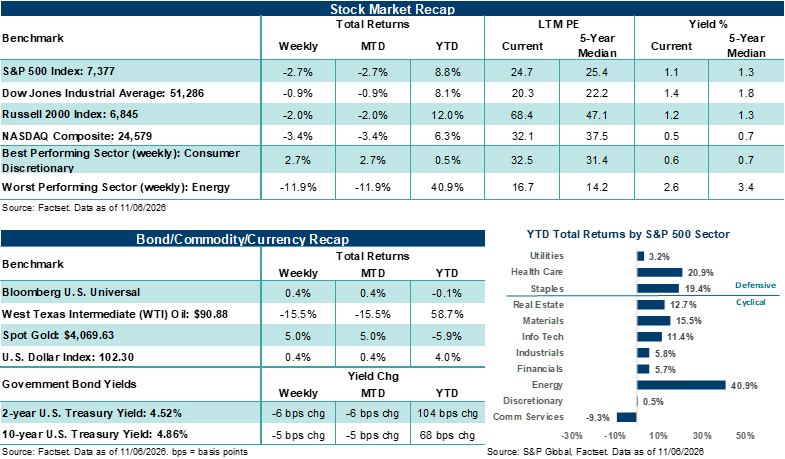
These figures are shown for illustrative purposes only and are not guaranteed. They do not reflect taxes or investment/product fees or expenses, which would reduce the figures shown here. An index is a statistical composite that is not managed. It is not possible to invest directly in an index. Past performance is not a guarantee of future results.
Important Disclosures
Sources: FactSet and Bloomberg. FactSet and Bloomberg are independent investment research companies that compile and provide financial data and analytics to firms and investment professionals such as Ameriprise Financial and its analysts. They are not affiliated with Ameriprise Financial, Inc.
The views expressed are as of the date given, may change as market or other conditions change, and may differ from views expressed by other Ameriprise Financial associates or affiliates. Actual investments or investment decisions made by Ameriprise Financial and its affiliates, whether for its own account or on behalf of clients, will not necessarily reflect the views expressed. This information is not intended to provide investment advice and does not account for individual investor circumstances.
Some of the opinions, conclusions and forward-looking statements are based on an analysis of information compiled from third-party sources. This information has been obtained from sources believed to be reliable, but accuracy and completeness cannot be guaranteed by Ameriprise Financial. It is given for informational purposes only and is not a solicitation to buy or sell the securities mentioned. The information is not intended to be used as the sole basis for investment decisions, nor should it be construed as advice designed to meet the specific needs of an individual investor.
Alternative investments cover a broad range of strategies and structures designed to be low or non-correlated to traditional equity and fixed-income markets with a long-term expectation of illiquidity. Alternative investments involve substantial risks and may be more volatile than traditional investments, making them more appropriate for investors with an above-average tolerance for risk.
Portfolios that hold a limited number of securities or concentrate investments in similar industries, sectors or geographical regions may experience greater volatility and greater risk of loss as the performance of these investments (either positive or negative) will have a greater impact on the portfolio as a whole.
International investing involves certain risks and volatility due to potential political, economic, social, or currency instabilities and different financial and accounting standards. These risks are enhanced for emerging markets.
Diversification does not assure a profit or protect against loss.
Commodity investments may be affected by the overall market and industry- and commodity-specific factors, and may be more volatile and less liquid than other investments.
There are risks associated with fixed-income investments, including credit (issuer default) risk, interest rate risk, and prepayment and extension risk. In general, bond prices rise when interest rates fall and vice versa. This effect is usually more pronounced for longer term securities.
Stock investments involve risk, including loss of principal. High-quality stocks may be appropriate for some investment strategies. Ensure that your investment objectives, time horizon and risk tolerance are aligned with investing in stocks, as they can lose value.
Investments in small cap companies involve risks and volatility greater than investments in larger, more established companies.
Generally, large-cap companies are more mature and have limited growth potential compared to smaller companies. In addition, large companies may not be able to adapt as easily to changing market conditions, potentially resulting in lower overall performance compared to the broader securities markets during different market cycles
The products of technology companies may be subject to severe competition and rapid obsolescence, and their stocks may be subject to greater price fluctuations.
Past performance is not a guarantee of future results.
An index is a statistical composite that is not managed. It is not possible to invest directly in an index.
Definitions of individual indices and sectors mentioned in this article are available on our website at ameriprise.com/legal/disclosures in the Additional Ameriprise research disclosures section.
The S&P 500 Index is a basket of 500 stocks that are considered to be widely held. The S&P 500 index is weighted by market value (shares outstanding times share price), and its performance is thought to be representative of the stock market as a whole. The S&P 500 index was created in 1957 although it has been extrapolated backwards to several decades earlier for performance comparison purposes. This index provides a broad snapshot of the overall US equity market. Over 70% of all US equity value is tracked by the S&P 500. Inclusion in the index is determined by Standard & Poor’s and is based upon their market size, liquidity, and sector.
The NASDAQ Composite index measures all NASDAQ domestic and international based common type stocks listed on the Nasdaq Stock Market.
The Dow Jones Industrial Average (DJIA) is an index containing stocks of 30 Large-Cap corporations in the United States. The index is owned and maintained by Dow Jones & Company.
The Russell 2000 Index measures the performance of the small-cap segment of the US equity universe. The Russell 2000 is constructed to provide a comprehensive and unbiased small-cap barometer and is completely reconstituted annually to ensure larger stocks do not distort the performance and characteristics of the true small-cap opportunity set. The Russell 2000 includes the largest 2000 securities in the Russell 3000.
The US Dollar Index (USDX) indicates the general international value of the USD. The USDX does this by averaging the exchange rates between the USD and major world currencies. This is computed by using rates supplied by approximately 500 banks.
West Texas Intermediate (WTI) is a grade of crude oil commonly used as a benchmark for oil prices. WTI is a light grade with low density and sulfur content.
The Philadelphia Semiconductor Index (SOX) is a stock market index that tracks the performance of companies in the semiconductor (chip) industry.
Third party companies mentioned are not affiliated with Ameriprise Financial, Inc.
Investment products are not insured by the FDIC, NCUA or any federal agency, are not deposits or obligations of, or guaranteed by any financial institution, and involve investment risks including possible loss of principal and fluctuation in value.
Securities offered by Ameriprise Financial Services, LLC. Member FINRA and SIPC.
© 2026 Ameriprise Financial, Inc. All rights reserved.