Will the Federal Reserve finally move off the sidelines?
ANTHONY SAGLIMBENE – CHIEF MARKET STRATEGIST, AMERIPRISE FINANCIAL
WEEKLY MARKET PERSPECTIVES — September 14, 2026

U.S. stocks finished lower last week, with the S&P 500 Index and NASDAQ Composite snapping two-week winning streaks as higher oil prices, firm inflation reports, and a sharp backup in Treasury yields pressured sentiment. This week, the September Federal Open Market Committee (FOMC) decision takes center stage.
Last week in review:
- The S&P 500 Index fell 0.8%, the NASDAQ Composite declined 0.6%, the Dow Jones Industrial Average dropped 1.6%, and the Russell 2000 Index lost 2.4%. Energy and Communication Services outperformed, while Healthcare, Materials, and Industrials lagged.
- August core CPI came in hotter than expected, with core services and supercore both firming. Some of the upside reflected a one-off increase in wireless services, while shelter and owners' equivalent rent stayed on a disinflationary path. August core PPI was slightly cooler, though firmer PCE-relevant components led some economists to raise core PCE tracking estimates.
- Consumer sentiment has weakened notably this month. Preliminary September University of Michigan sentiment fell to 47.8, well below consensus and the lowest headline reading since May's record low. Year-ahead inflation expectations rose to +4.6% from +4.0%, while longer-run expectations ticked up to +3.4%.
- Treasury yields moved sharply higher, with short-end yields up 24 to 28 basis points and the 30-year touching 5.38% intraweek, its highest level since June 2004. The U.S. Dollar Index was flat, Gold fell 1.8%, and West Texas Intermediate (WTI) crude rose +8.0%, settling just above $100 per barrel.
- Geopolitical risk intensified. Increased military activity around Iran pushed crude prices higher and U.S. diesel prices above $6 per gallon. Houthi advances toward the Red Sea raised concerns about a second shipping chokepoint.
- However, AI sentiment remained a bright spot. Oracle reported accelerating cloud infrastructure growth and strong bookings, Microsoft was reported to be planning a significant expansion of data center capacity, and OpenAI paused Pro subscriptions amid outsized demand for its new Astra model.
- Finally, the 30-year fixed mortgage rate moved above 7.0%, its highest level since May 2025. And Citigroup's U.S. Earnings Revisions Index has now been positive for 21 straight weeks, the longest stretch since September 2021.
“Given current inflation dynamics, a solid employment backdrop, and a new Fed Chair looking to establish credibility, Wednesday’s rate decision carries the highest odds of a hike markets have seen all year. As such, we believe investors should be prepared for the committee to act this week, even if there’s still a small chance Fed Chair Warsh and company decide to stand pat.”
Anthony Saglimbene - Chief Market Strategist, Ameriprise Financial
Will the Federal Reserve finally move off the sidelines?
All eyes turn to the Federal Reserve this week. Notably, policymakers haven’t changed interest rate policy since December 2025. Thus, this week’s two-day meeting follows five consecutive meetings with the fed funds target range parked at 3.50%-3.75%. But given current inflation dynamics, a solid employment backdrop, and a new Fed Chair looking to establish credibility, Wednesday’s rate decision carries the highest odds of a hike markets have seen all year. As such, we believe investors should be prepared for the committee to act this week, even if there’s still a small chance Fed Chair Warsh and company decide to stand pat.
Simply, Friday's inflation report pushed the odds higher that the Fed will finally move off the sidelines. The headline Consumer Price Index (CPI) rose +0.4% month over month in August and held at +3.4% year over year. In addition, core CPI, which strips out food and energy, rose +0.3% for the month after a +0.2% gain in July, and one-tenth above the consensus estimate. However, on the year-over-year rate, core CPI dipped to +2.4% in August, down from +2.5% in July. Yet, with core CPI again holding above the Fed’s +2.0% target last month, traders responded by pushing the probability of a quarter-point hike this week to over 85% on Friday, up from roughly 70% before the release. That said, the Committee that voted nine to three to hold rates steady in July can point to at least “steadier” inflation levels (if they want to) and as cover to wait another meeting before acting, in our view.
That’s because energy is doing most of the damage on the inflationary front at present, something the Fed can’t directly influence. For example, gasoline prices rose by +3.9% in August and accounted for more than a third of the entire monthly headline CPI increase. Notably, over the last twelve months, gasoline prices are up +27.4%, and fuel oil is up +52.0%. In our view, the uptick in inflation pressures is energy-driven and a supply problem rooted in a geopolitical issue. A quarter-point move in the fed funds rate won’t address this issue.
Nevertheless, the still-strong labor market may give officials some cover to move rates higher if they choose to do so this week. For example, August payrolls came in at +162,000 against a consensus of +55,000, with the unemployment rate holding steady at 4.1% and wage growth at +3.1% year over year. Over the last three months, job growth has averaged a very healthy +71,000 per month, suggesting the labor market is more than capable of absorbing a quarter-point rate hike should policymakers decide to get ahead of higher energy prices filtering into core inflation.
As the chart above shows, in June, Fed officials projected core PCE inflation at +3.3%, headline PCE at +3.6%, unemployment at 4.3%, and a year-end median fed funds rate of 3.8%. Interestingly, core inflation so far is landing within officials’ forecasts, and headline inflation is running a little hot (mostly because of energy, which, as we noted above, the Fed can’t control). Interestingly, unemployment, which was at 4.1% at the end of August, is coming in below even the lowest projection any official submitted in June. Overall, the Fed's inflation forecast is holding up, while the labor market has likely remained tighter and stronger than most expected. We’ll soon see where policymakers pencil in their updated forecasts this week when the Fed’s Summary of Economic Projections is updated alongside their rate decision.
It’s also worth pointing out that the Fed doesn’t target CPI specifically when setting policy, which is what rate odds reacted to on Friday. Instead, the Fed targets the Personal Consumption Expenditures (PCE) Index, which weights housing costs (for example) far less heavily and adjusts for the way people actually shop when prices rise. Notably, core CPI stood at +2.4% in August, while the Fed's preferred gauge sat higher in July at +3.3%. Hence, while Friday's CPI report looked encouraging on the surface, the measure the Fed actually uses to judge whether it has done enough on inflation remains well above target.
Also, since CPI and PCE both remain above target levels, and given that Friday's CPI data didn’t change the inflation narrative much, traders quickly priced in that the Fed has the runway to raise rates on Wednesday. At the end of the day, the Fed has seldom disappointed markets when the odds of a rate hike or cut are this high, suggesting again that investors would be best served by assuming policy rates are moving higher this week.
With that backdrop in place, what other items should investors be watching for beyond the Fed's rate decision? We would start with the updated economic projections. Specifically, we believe the 2026 rate projection, or median dot, is the number that matters most for the market right now. June projections placed that dot at 3.8%, which sits halfway between holding rates steady and delivering one hike. Interestingly, that split tells you how evenly divided the Committee was three months ago.
So, watch where the dot lands this week. If it shows one hike for the year, officials view Wednesday's likely move as the last of 2026. If it shows two (which we think it will), they expect to move again before year-end, with only October and December meetings remaining to do it. Interestingly, futures markets are already priced for two quarter-point rate hikes by December, taking the fed funds rate from the upper bound of 3.75% today to 4.25%. The path traders expect is a move on Wednesday, a pause in October (ahead of the November election), then a second hike in December. If the Fed's own projections show only one hike instead, something will have to give. Either shorter-term bond yields fall back as traders unwind the December move, or the Fed eventually follows through and validates the market pricing. We believe either outcome could create some volatility over the coming days and weeks. Investors should also watch the long-run projections and officials' views on where rates will settle once conditions normalize. A further increase in longer-term projections would suggest the Committee believes borrowing costs could stay structurally higher.
But under Fed Chair Warsh, these projections come with new wrinkles. Warsh has spent his first months on the job preparing to reduce what the Fed tells markets in advance. Already, statements have gotten shorter, and July's statement was nearly identical to June's. And one participant even declined to submit a rate projection in June. Want to venture a guess who that was? In our view, these small actions are consistent with Warsh’s overarching view that officials should say and forecast less to the public. Importantly, regarding this week's rate projection updates, if an important participant again sits out, the published median dot may not fully reflect the decision-maker's view. All this said, over the coming months, we do expect a clearer view of how Warsh intends to communicate policy when findings from his current task forces are completed.
Bottom line: Investors should plan for a quarter-point rate hike this week. It's pretty much baked in, and there’s little risk for officials to do so. Underneath the energy noise, the fundamental picture remains steady. Core inflation is tracking right where the Committee projected it in June, payrolls beat handily in August, and unemployment sits below where the Fed projected the level in June. In our view, this economy can handle one or two quarter-point rate hikes, and policymakers may well decide that getting ahead of energy bleeding into core inflation is worth the effort. Importantly, the recent move higher in long-term yields will likely tighten financial conditions over time, possibly helping to bring down core inflation pressures. We suspect Warsh would be on board with such a dynamic as long as tighter conditions lead to an orderly decline in price pressures and avoid large growth disruptions.
The week ahead:
- In addition to this week's closely watched Fed decision, August retail sales on Wednesday will offer an important read on whether consumer spending is holding up against higher energy prices and weakening sentiment.
- Other data releases this week include the September Empire State Index on Tuesday, housing starts, building permits, Philadelphia Fed manufacturing on Thursday, and industrial production on Friday.
- Earnings are light, with Lennar reporting on Wednesday and Carnival reporting results on Thursday.
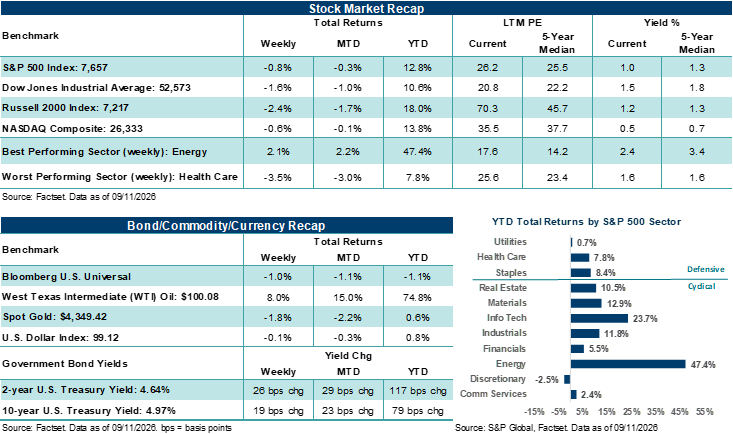
These figures are shown for illustrative purposes only and are not guaranteed. They do not reflect taxes or investment/product fees or expenses, which would reduce the figures shown here. An index is a statistical composite that is not managed. It is not possible to invest directly in an index. Past performance is not a guarantee of future results.
Sources: FactSet and Bloomberg. FactSet and Bloomberg are independent investment research companies that compile and provide financial data and analytics to firms and investment professionals such as Ameriprise Financial and its analysts. They are not affiliated with Ameriprise Financial, Inc.
The views expressed are as of the date given, may change as market or other conditions change, and may differ from views expressed by other Ameriprise Financial associates or affiliates. Actual investments or investment decisions made by Ameriprise Financial and its affiliates, whether for its own account or on behalf of clients, will not necessarily reflect the views expressed. This information is not intended to provide investment advice and does not account for individual investor circumstances.
Some of the opinions, conclusions and forward-looking statements are based on an analysis of information compiled from third-party sources. This information has been obtained from sources believed to be reliable, but accuracy and completeness cannot be guaranteed by Ameriprise Financial. It is given for informational purposes only and is not a solicitation to buy or sell the securities mentioned. The information is not intended to be used as the sole basis for investment decisions, nor should it be construed as advice designed to meet the specific needs of an individual investor.
Alternative investments cover a broad range of strategies and structures designed to be low or non-correlated to traditional equity and fixed-income markets with a long-term expectation of illiquidity. Alternative investments involve substantial risks and may be more volatile than traditional investments, making them more appropriate for investors with an above-average tolerance for risk.
Portfolios that hold a limited number of securities or concentrate investments in similar industries, sectors or geographical regions may experience greater volatility and greater risk of loss as the performance of these investments (either positive or negative) will have a greater impact on the portfolio as a whole.
International investing involves certain risks and volatility due to potential political, economic, social, or currency instabilities and different financial and accounting standards. These risks are enhanced for emerging markets.
Diversification does not assure a profit or protect against loss.
Commodity investments may be affected by the overall market and industry- and commodity-specific factors, and may be more volatile and less liquid than other investments.
There are risks associated with fixed-income investments, including credit (issuer default) risk, interest rate risk, and prepayment and extension risk. In general, bond prices rise when interest rates fall and vice versa. This effect is usually more pronounced for longer term securities.
Stock investments involve risk, including loss of principal. High-quality stocks may be appropriate for some investment strategies. Ensure that your investment objectives, time horizon and risk tolerance are aligned with investing in stocks, as they can lose value.
Investments in small cap companies involve risks and volatility greater than investments in larger, more established companies.
Generally, large-cap companies are more mature and have limited growth potential compared to smaller companies. In addition, large companies may not be able to adapt as easily to changing market conditions, potentially resulting in lower overall performance compared to the broader securities markets during different market cycles
The products of technology companies may be subject to severe competition and rapid obsolescence, and their stocks may be subject to greater price fluctuations.
Past performance is not a guarantee of future results.
An index is a statistical composite that is not managed. It is not possible to invest directly in an index.
Definitions of individual indices and sectors mentioned in this article are available on our website at ameriprise.com/legal/disclosures in the Additional Ameriprise research disclosures section.
The S&P 500 Index is a basket of 500 stocks that are considered to be widely held. The S&P 500 index is weighted by market value (shares outstanding times share price), and its performance is thought to be representative of the stock market as a whole. The S&P 500 index was created in 1957 although it has been extrapolated backwards to several decades earlier for performance comparison purposes. This index provides a broad snapshot of the overall US equity market. Over 70% of all US equity value is tracked by the S&P 500. Inclusion in the index is determined by Standard & Poor’s and is based upon their market size, liquidity, and sector.
The NASDAQ Composite index measures all NASDAQ domestic and international based common type stocks listed on the Nasdaq Stock Market.
The Dow Jones Industrial Average (DJIA) is an index containing stocks of 30 Large-Cap corporations in the United States. The index is owned and maintained by Dow Jones & Company.
The Russell 2000 Index measures the performance of the small-cap segment of the US equity universe. The Russell 2000 is constructed to provide a comprehensive and unbiased small-cap barometer and is completely reconstituted annually to ensure larger stocks do not distort the performance and characteristics of the true small-cap opportunity set. The Russell 2000 includes the largest 2000 securities in the Russell 3000.
The US Dollar Index (USDX) indicates the general international value of the USD. The USDX does this by averaging the exchange rates between the USD and major world currencies. This is computed by using rates supplied by approximately 500 banks.
West Texas Intermediate (WTI) is a grade of crude oil commonly used as a benchmark for oil prices. WTI is a light grade with low density and sulfur content.
The ISM Services PMI (formerly the Non-Manufacturing NMI) is compiled and issued by the Institute of Supply Management (ISM) based on survey data. The ISM services report contains the economic activity of more than 15 industries, measuring employment, prices, and inventory levels; above 50 indicating growth, while below 50 indicating contraction.
Third party companies mentioned are not affiliated with Ameriprise Financial, Inc.
Investment products are not insured by the FDIC, NCUA or any federal agency, are not deposits or obligations of, or guaranteed by any financial institution, and involve investment risks including possible loss of principal and fluctuation in value.
Securities offered by Ameriprise Financial Services, LLC. Member FINRA and SIPC.
© 2026 Ameriprise Financial, Inc. All rights reserved.