Understand the foundational investing concepts that can help you manage risk, prioritize growth and pursue your long-term goals.

It’s not possible to predict what the markets will do in the future. Economic shifts, market volatility and changing personal circumstances can all create uncertainty for investors. But a sound investment strategy isn’t built on short-term predictions. By following time-tested principles, you can make more informed decisions and stay on track through changing market conditions.
The seven principles below can provide a foundation for investing with greater discipline and confidence over time. An Ameriprise financial advisor can help you apply and balance these and other strategies based on your goals, time horizon and comfort with risk. They can also help you adjust your investment approach as your life evolves and navigate short-term market changes without losing sight of what matters most to you.
1. Leverage the power of compound growth
When your investments earn money, reinvesting those earnings gives them the opportunity to generate earnings of their own. This is known as compound growth. Over time, this cycle can help your money grow faster without requiring you to invest more.
The earlier you start investing, the more time your money has to benefit from compounding. Even modest earnings can build on one another over the years, potentially increasing your overall returns.
This snowball effect can make a meaningful difference in how much your investment may ultimately be worth. For example, the graphic below shows how an initial $10,000 investment growing 7% each year could add up over time as your earnings begin generating earnings of their own. Even without any additional investment contributions, $10,000 can turn into $76,122 over 30 years thanks to compounding growth.
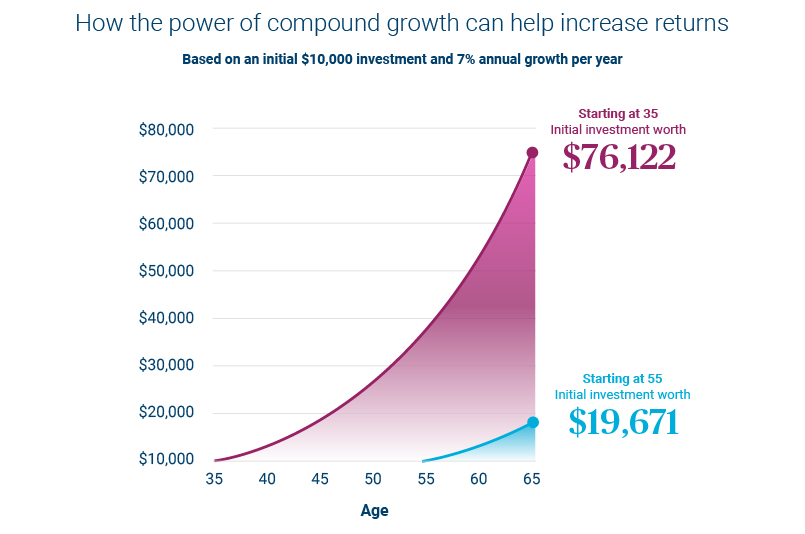
*This illustration is hypothetical and is meant to show the effects of compound interest. It is not meant to represent the past or future returns of any specific investment or investment strategy, or imply any guaranteed earnings. This illustration does not reflect sales charges or other expenses that may be required for some investments.

See compound growth in action
See how your money could grow over time with our compounding interest calculator.
2. Consider dollar-cost averaging to automate your investing
While dollar-cost averaging may sound technical, it’s a straightforward way to automate your investing and spread your purchases across a range of market prices.
With dollar-cost averaging, you invest the same amount on a regular schedule, regardless of whether the market is up or down. That means your money buys more shares when prices are lower and fewer when prices are higher, which can help reduce the risk of investing all your money at an unfavorable time. If you contribute to your 401(k) from every paycheck, you’re likely already using dollar-cost averaging as part of your investment strategy.
Dollar-cost averaging may be especially helpful if you feel nervous about investing a large amount at once or want a consistent, systematic way to make investing part of your regular financial routine.
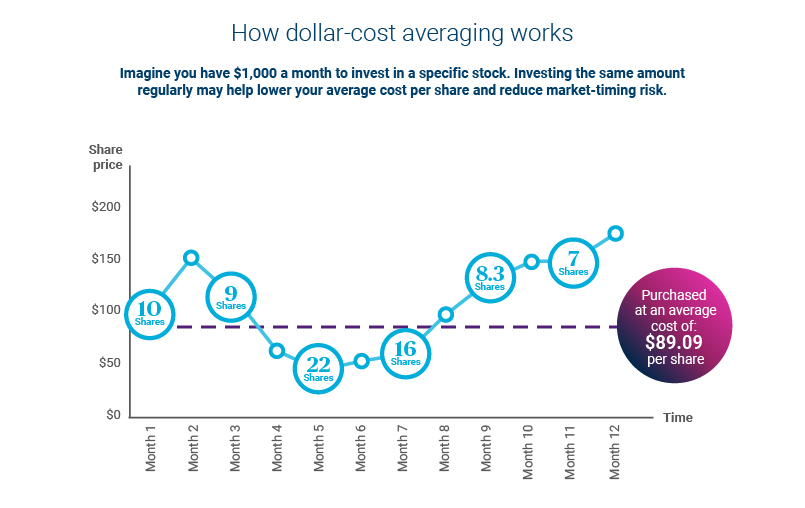
This illustration is hypothetical and is not meant to represent any specific investment or imply any guarantee.
3. Remember: Time in the market beats market timing
Time in the market means staying invested through market ups and downs so your money has more opportunity to grow over the long term. Market timing takes the opposite approach: buying or selling based on where you think prices are headed next. While that may sound appealing, it’s impossible to consistently predict the market’s best and worst days.
Some of the market’s strongest days occur close to its steepest declines, making it especially difficult to know when to buy or sell. Selling during a downturn could cause you to miss the rebound that follows and diminish your long-term returns. By remaining invested instead of reacting to short-term swings, you give your portfolio the chance to participate in the market’s recovery and potential growth.
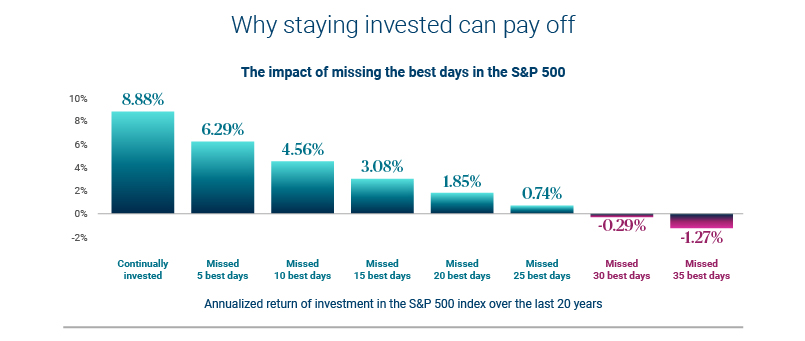
Source: Bloomberg, S&P Dow Jones Indices, American Enterprise Investment Services, Inc. Data as of 12/31/2025. Returns assume the investor was fully and continually invested in the S&P 500 Price Return Index except for the days specified. Calculations assume no fees or transaction costs. These figures are shown for illustrative purposes only and are not guaranteed. An index is a statistical composite that is not managed. It is not possible to invest directly in an index. Past performance is not a guarantee of future results.
Learn more: 7 reasons to stay invested during market uncertainty
4. Take emotion out of investing decisions
Market ups and downs can stir up strong emotions. When prices fall, fear may make you want to sell to avoid further losses. When markets are rising, excitement can lead you to invest more aggressively or chase investments that have recently performed well.
These reactions are natural, but acting on them can lead you to buy or sell at the wrong time. Dollar-cost averaging is one way to avoid emotional decision-making and keep investing during changing market conditions. If you are retired, organizing your investments into separate buckets for near-term needs and longer-term goals can also make it easier to avoid reacting to short-term market swings. Beyond these investing approaches, having a long-term investment strategy in place can help you look beyond short-term market movements and make decisions based on your goals, time horizon and comfort with risk.
Learn more: How to navigate market volatility
5. Define your risk tolerance and risk capacity
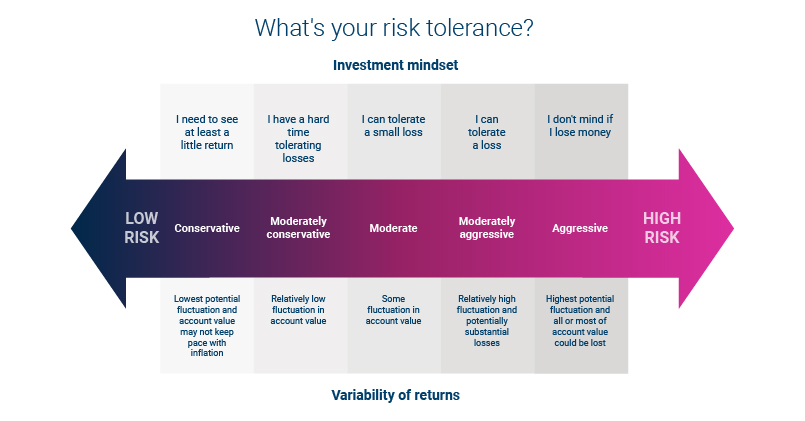
Risk tolerance is the amount of potential investment loss you’re willing to accept when markets decline. It reflects how comfortable you feel when your account value declines. Risk capacity, on the other hand, is your financial ability to absorb a loss without putting your goals at risk. Understanding both your risk tolerance and risk capacity can help you choose an appropriate balance between growth potential and stability.
Both may change over time. If you have many years before you need the money, you may have greater capacity to withstand short-term market declines, and may be more comfortable with investments that have larger short-term swings in exchange for greater growth potential. As a major goal approaches, such as retirement, you may prefer a more conservative mix. Considering your risk tolerance, risk capacity and investing time frame can help you divide your money among stocks, bonds and other investments in a way that supports your financial needs and makes it easier to stay invested through changing markets.

Take our risk tolerance quiz
You can determine your risk tolerance for investing by answering a few questions.
6. Use diversification and asset allocation to manage risk
Asset allocation and diversification are complementary investing strategies that can help manage the impact of market swings on your portfolio.
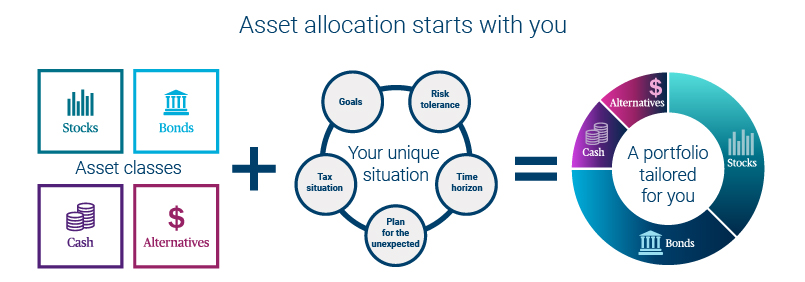
Asset allocation determines how your portfolio is divided among different asset classes, such as stocks, bonds, alternative investments and cash. The mix that fits your circumstances is based on factors such as your goals, risk tolerance, time horizon and tax situation, all of which can change over time. For example, a retiree who relies on their portfolio for income may hold a larger allocation to bonds and cash to help cover near-term expenses and potentially reduce the impact of market fluctuations.
Diversification builds on your asset allocation strategy by spreading investments across and within asset classes, including different sectors, regions, company sizes and other investment characteristics. Because various investments may perform differently under changing market conditions, diversification can help reduce the impact that a decline in any one area may have on your overall portfolio.
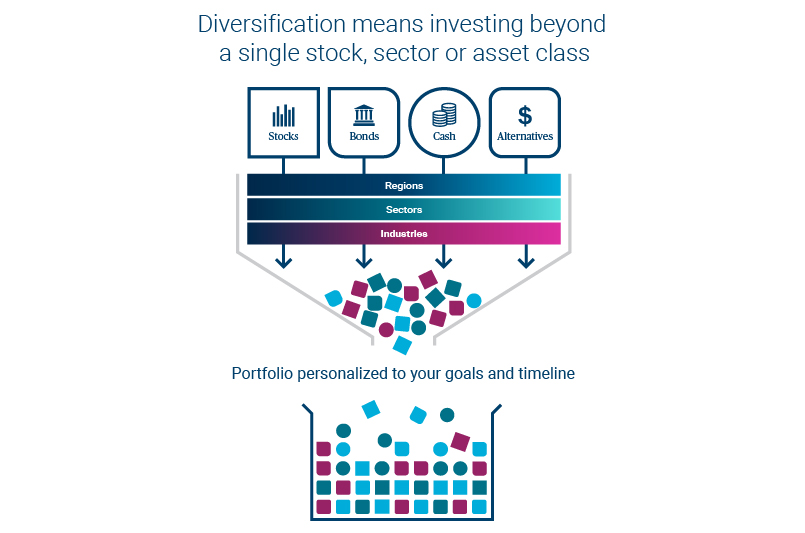
In short, asset allocation and diversification work together to help manage risk and keep your portfolio aligned with your long-term financial goals.
Learn more: Why should you consider diversification and asset allocation?
7. Review and rebalance your portfolio regularly
Over time, some investments in your portfolio may gain or lose value faster than others, shifting your portfolio away from its intended asset allocation. For example, if stocks outperform bonds, stocks may grow to represent a larger share of your portfolio than you planned, potentially exposing you to more risk than you planned. Changes in your income, goals, time horizon or risk tolerance can also mean your current investment mix no longer fits your needs.
Rebalancing is the process of adjusting your investments to bring your portfolio back to its target allocation. This may involve selling investments that make up too much of your portfolio, buying more of those that make up too little or directing new contributions toward underrepresented areas. Reviewing your portfolio regularly — such as once a year or after a major life change — can help determine whether rebalancing is needed.
Learn more: Why rebalancing your portfolio regularly is important
Put these investing principles into action
An Ameriprise financial advisor can help you put these principles into practice by building a diversified portfolio around your goals and adjusting your investment strategy as your life and the markets change.
One of your clients has some questions they would like to discuss with you at your next meeting.
warning Something went wrong. Do you want to try reloading? Try again
When you’re ready to reach out to an Ameriprise financial advisor for a complimentary initial consultation, consider bringing these questions to your meeting.
Reach out to %advisor% to start the conversation.
Or, request an appointment online to speak with an advisor.
At Ameriprise, the financial advice we give each of our clients is personalized, based on your goals and no one else's.
If you know someone who could benefit from a conversation, please refer me.
Background and qualification information is available at FINRA's BrokerCheck website.