Turn your peak earning years into bigger retirement savings with catch-up contributions.

Saving for retirement is a gradual journey, but as you approach your target date, you may want to accelerate your progress. Catch-up contributions provide a powerful way for investors age 50 and older to boost their savings and make the most of their peak earning years.
An Ameriprise financial advisor can help you understand the potential impact of catch-up contributions and determine how they can fit into your broader retirement savings strategy.
Here’s how catch-up contributions work:
What are catch-up contributions?
Catch-up contributions are additional contributions that people age 50 and older can make to certain retirement accounts above the standard annual contribution limits. Established by the IRS, these contributions are designed to help individuals "catch up" on their retirement savings and make the most of their remaining working years before retirement.
Catch-up contributions have several benefits:
-
Tax advantages: Catch-up contributions allow you to shelter more of your income from current taxes or, in the case of Roth accounts, build a larger pool of tax-free money for the future.
-
Momentum: Saving more during your highest-earning years can provide a final, powerful boost to your investment portfolio before you begin drawing down those assets in retirement.
-
Extra buffer in retirement: Catch-up contributions can help offset the impacts of inflation and unexpected expenses that may arise later in life.
Learn more: How to make the most of your retirement savings
What are the catch-up contribution limits?
The amount you can set aside as a catch-up contribution depends on the type of retirement account you hold and your age. The IRS periodically updates these limits to keep pace with inflation, meaning the exact dollar amounts can change from year to year.
Here is a look at the maximum individual contribution and catch-up limits for 2026:
|
Retirement account |
Annual limit |
Catch-up contribution |
Total possible contribution |
|---|---|---|---|
|
Traditional and Roth IRAs |
$7,500 |
$1,100 (ages 50+) |
$8,600 |
|
SIMPLE IRA and SIMPLE 401(k) |
$17,000 |
$4,000 (ages 50+) |
$21,000 (ages 50+) |
|
SIMPLE IRA and SIMPLE 401(k) if 25 or fewer employees or more than 25 employees if the employer is making a 4% match or 3% non-elective contribution |
$18,100 |
$3,850 (ages 50+) $5,250 (ages 60-63) |
$21,950 (ages 50+) $23,350 (ages 60-63) |
|
401(k), 403(b), 457(b) |
$24,500 |
$8,000 (ages 50+) |
$32,500 (ages 50+) |
How can catch-up contributions boost your retirement savings?
The value of catch-up contributions comes not only from saving more, but also from giving those additional dollars time to grow. In the hypothetical scenario below, an investor starts making the maximum allowable catch-up contributions to their 401(k) at age 50 and continues through age 64. The chart illustrates how those extra contributions, combined with potential investment growth, can help increase retirement savings over time.
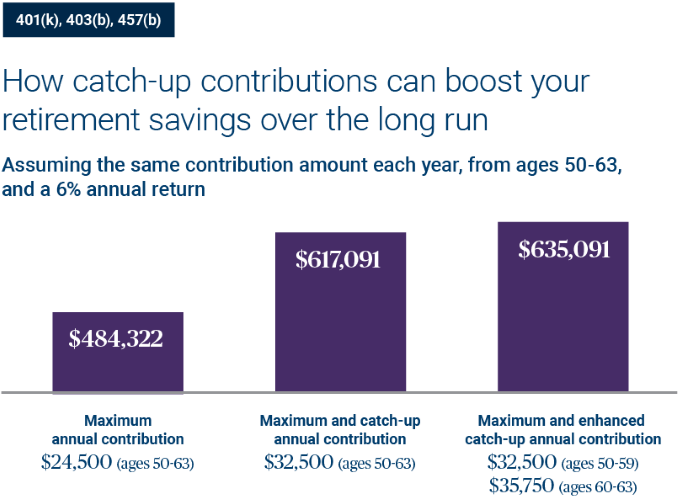
*The numbers in the chart assume a 6% annual compounded return over 14 years. This illustration is hypothetical and is not meant to represent a specific investment or imply any guaranteed rate of return. It also does not account for any matching contributions from an employer.
What are the age requirements to make catch-up contributions?
You must turn 50 or older by the end of the calendar year to be eligible. Even if your 50th birthday falls on Dec. 31, the IRS allows you to make catch-up contributions for that entire calendar year. The same is true for the age 60-63 catch-up. In the year you turn 64, you are no longer eligible for the age 60-63 catch-up and return to the age 50+ limit.
Are there income requirements or limits to make catch-up contributions?
There are no income limits for making catch-up contributions. Anyone who qualifies by age can contribute, regardless of how much they earn.
However, if you’re a higher earner, you may be subject to IRS rules that affect how you make those extra contributions. Above a certain income level, catch-up contributions to employer-sponsored plans — such as a 401(k) ,403(b) or governmental 457(b) — may need to be made on a Roth (after-tax) basis instead of the traditional pre-tax option. For 2026 the rule applies if your 2025 wages with the employer sponsoring the plan were over $150,000. This rule does not apply to IRA plans.
Learn more: How new 2026 catch-up contribution rules could impact your finances
Are all workplace retirement plans required to allow catch-up contributions?
While the IRS permits catch-up contributions, you can only make them if your employer’s retirement plan, such as a 401(k) or 403(b), allows them. Most plans do offer catch-up contributions, but it’s a good idea to confirm with your human resources team or plan administrator.
Do catch-up contributions make sense for you?
Catch-up contributions are an excellent tool for many, but there may be scenarios where it makes more sense to allocate those extra funds elsewhere:
-
After-tax retirement plan contributions: If your employer-sponsored retirement plan allows after-tax contributions, directing additional savings there may be an alternative to catch-up contributions. Depending on your plan's provisions, you could later convert these contributions to a Roth IRA, which can potentially provide added flexibility and offer a broader range of investment options that are better suited to your diversification and retirement goals.
-
Annuity or insurance solutions: Instead of a catch-up contribution, it may make sense to use your funds to purchase another solution, like an annuity or insurance product that fills a specific gap in your overall financial strategy. These products can offer guaranteed income or necessary protection for your family, which might take priority over accumulating more assets in a 401(k) or IRA.
-
Taxable accounts: Perhaps you saved aggressively for retirement in your early years, and your traditional accounts are already well-funded. In that case, it could benefit you to access these funds without all the limitations that come with a retirement account. For example, building up a taxable brokerage account or cash investments can provide liquidity before you reach age 59½, which is when you can generally start withdrawing from retirement accounts without facing early withdrawal penalties. Overall, funds in taxable accounts are generally more flexible, giving you the freedom to retire early, start a business or manage large, unexpected expenses.
-
Other financial goals: Balancing your immediate financial needs with your long-term retirement goals requires a pragmatic approach. Paying down high-interest debt, supporting a child’s education or building an emergency fund are all possible reasons to momentarily pause on catch-up contributions. Additionally, maybe other priorities — such as monetary gifts to loved ones or a special charitable cause — are more important to you than increasing your retirement savings.
Make your money go further
An Ameriprise financial advisor can help you explore how catch-up contributions may enhance your retirement savings strategy and long-term goals.
One of your clients has some questions they would like to discuss with you at your next meeting.
warning Something went wrong. Do you want to try reloading? Try again
When you’re ready to reach out to an Ameriprise financial advisor for a complimentary initial consultation, consider bringing these questions to your meeting.
Reach out to %advisor% to start the conversation.
Or, request an appointment online to speak with an advisor.
At Ameriprise, the financial advice we give each of our clients is personalized, based on your goals and no one else's.
If you know someone who could benefit from a conversation, please refer me.
Background and qualification information is available at FINRA's BrokerCheck website.
All guarantees are subject to the claims-paying ability of the issuing insurance company.