Make sure your old 401(k) is still working toward your financial goals and explore the different options available to you.
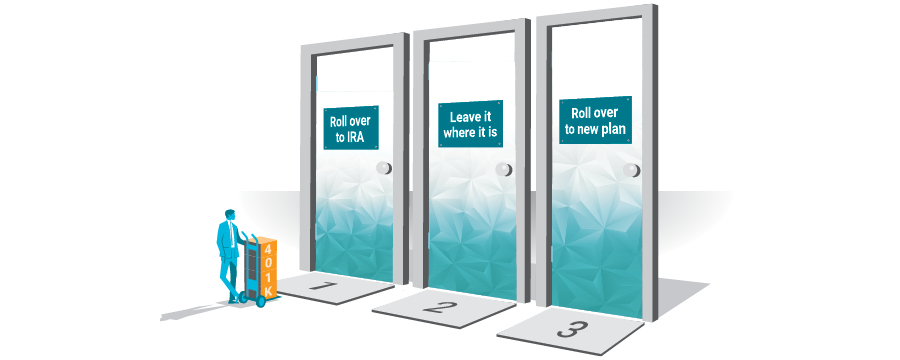
If you have had multiple employers over the course of your career, you likely have one (or more) old 401(k) plans from a previous job. But is this the most effective way to manage your retirement funds?
Ultimately, how you handle an old 401(k) will depend on your unique financial situation and personal preferences. An Ameriprise financial advisor can help you review your options for your old 401(k) and find a solution that supports your financial goals.
Here are the four main options you have with an old 401(k) when switching jobs:
Option #1: Leave your 401(k) where it is
If your previous employer’s 401(k) allows you to maintain your account — and you are happy with the plan’s investment options and fee structure — you can leave it where it is. However, while it’s a convenient option, it’s not uncommon for investors to lose track of old accounts. If you do decide to leave your old 401(k) where it is, regularly check your plan, review your investments as part of your overall portfolio and keep your beneficiaries updated within the account.
Here’s what else to consider:
-
Account size: If you have less than $5,000 in a former employer’s 401(k), you may be required to transfer your money out. If you have less than $1,000 in the account, your former employer will likely cut you a check for the amount. If that happens, you will need to deposit the check into your new employer's 401(k) or into an IRA within 60 days of receiving it to avoid paying an early-withdrawal penalty and any taxes on the money.
-
Employer stock: If your account includes publicly traded stock in your former company — and that stock has grown significantly in value – you would lose the option to apply a special tax treatment known as net unrealized appreciation (NUA) if you choose the option to roll over your account into your new employer’s 401(k) or into an IRA.
-
Vesting schedule: If your previous employer contributes matching funds to your 401(k), the money typically vests over time. If you're not fully vested when you leave the employer, you'll get to keep only a portion of the match — or none at all. Talk to your plan administrator to understand your company’s vesting schedule.
-
Fees: 401(k) plans come with maintenance and transaction fees that can diminish the value of your investment returns. Make sure you understand how much you’re paying in fees for your old 401(k) — if it’s a significant amount, you may want to consider other options.
Option #2: Roll over your old 401(k) into your new 401(k)
With this option, you transfer the savings from your old 401(k) into your new employer’s retirement plan, consolidating your funds into one place. This can make it easier to track and manage your retirement investments. However, before you choose this course of action, compare the fees and investment options from your new employer's plan.
Here’s what else to consider:
-
Direct rollovers: A direct rollover gives you the option to transfer funds from your old plan directly into your new employer’s 401(k) without incurring taxes or penalties. You can then allocate your savings into the new investment options.
-
Transfer rules: Failure to follow 401(k) transfer rules may result in additional penalties and taxes. For example, if you don’t do a direct rollover and receive the funds from your previous employer’s plan in the form of a check, a mandatory 20% withholding will apply. What’s more, if you don’t deposit the check within 60 days of receiving it and are under the age of 59½, you’ll pay a 10% early withdrawal penalty on top of any income taxes owed on the distribution.
-
401(k) loans: Some employer retirement plans allow you to borrow money from your 401(k). If you roll over your old plan into your new plan, you have the added benefit of having a larger balance to borrow against. Generally, you are not allowed to borrow money from an old 401(k).
Rollover evaluator
Our rollover evaluator can help you understand the pros and cons of keeping your old employer-sponsored 401(k) or rolling it over into an IRA.
Option #3: Roll over your old 401(k) into an IRA
The main benefit of rolling your 401(k) into an IRA is that you’ll have greater control over your retirement savings. Here’s why: Because you can choose where to open your IRA, you have the freedom to pick a broker that provides a wider and better range of investment options. You don’t have that flexibility with an employer-sponsored plan.
If you decide to transfer your old 401(k) funds into an IRA, there are several different rollover options, each of which has different tax implications. Here's what to consider:
-
Traditional IRA rollover: If you roll over your old 401(k) to a traditional IRA, no taxes will be due when you move the money, and any new earnings will accumulate tax-deferred. You'll only pay taxes when you take withdrawals, but you will have to take required minimum distributions (RMDs) once you turn 73 years old. (The RMD age will increase to 75 in 2033.)
-
Traditional 401(k) to Roth IRA rollover: You can roll over all or part of your old 401(k) directly to a Roth IRA; however, you will have to pay taxes on the money you convert in the year you convert. That’s because Roth retirement accounts are funded with after-tax dollars, while traditional 401(k)s are funded with pretax dollars. Once you make the conversion, there are no RMDs and any earnings that accumulate will be eligible for tax-free withdrawal, as long as your Roth IRA has been open at least five years and you are at least 59½ years old.
-
Roth 401(k) to Roth IRA rollover: Unlike a traditional 401(k), which is funded with pretax dollars, a Roth 401(k) is funded with after-tax money. When you roll over a Roth 401(k) to a Roth IRA, no taxes are due when the money is moved, and any new earnings accumulate tax-free if certain conditions are met. Earnings are eligible for tax-free withdrawal once the Roth IRA has been open at least five years and you reach age 59½.
Option #4: Cash out your old 401(k)
Cashing out your old 401(k) simply involves converting the account funds to cash. However, this option is generally not advisable as it comes with significant financial consequences and could set you back on your retirement savings journey.
Here's what to consider:
-
Taxes: The cash you withdraw from your 401(k) is considered income, which means you will likely face a substantial tax bill.
-
Penalties: If you leave your employer prior to the year you turn 55 and are younger than age 59½, you will be required to pay a 10% early withdrawal penalty to the IRS on top of any taxes you may owe.
-
Loss of investment growth: You will lose the benefit of giving your 401(k) investments time to grow, and you may need to work longer to make up the difference.
Understand your 401(k) options
An Ameriprise financial advisor can help you consider the options you have with your 401(k) that will help support your retirement goals.
One of your clients has some questions they would like to discuss with you at your next meeting.
warning Something went wrong. Do you want to try reloading? Try again
When you’re ready to reach out to an Ameriprise financial advisor for a complimentary initial consultation, consider bringing these questions to your meeting.
Reach out to %advisor% to start the conversation.
Or, request an appointment online to speak with an advisor.
At Ameriprise, the financial advice we give each of our clients is personalized, based on your goals and no one else's.
If you know someone who could benefit from a conversation, please refer me.
Background and qualification information is available at FINRA's BrokerCheck website.